Full bars but no data in a crowd? Here's why
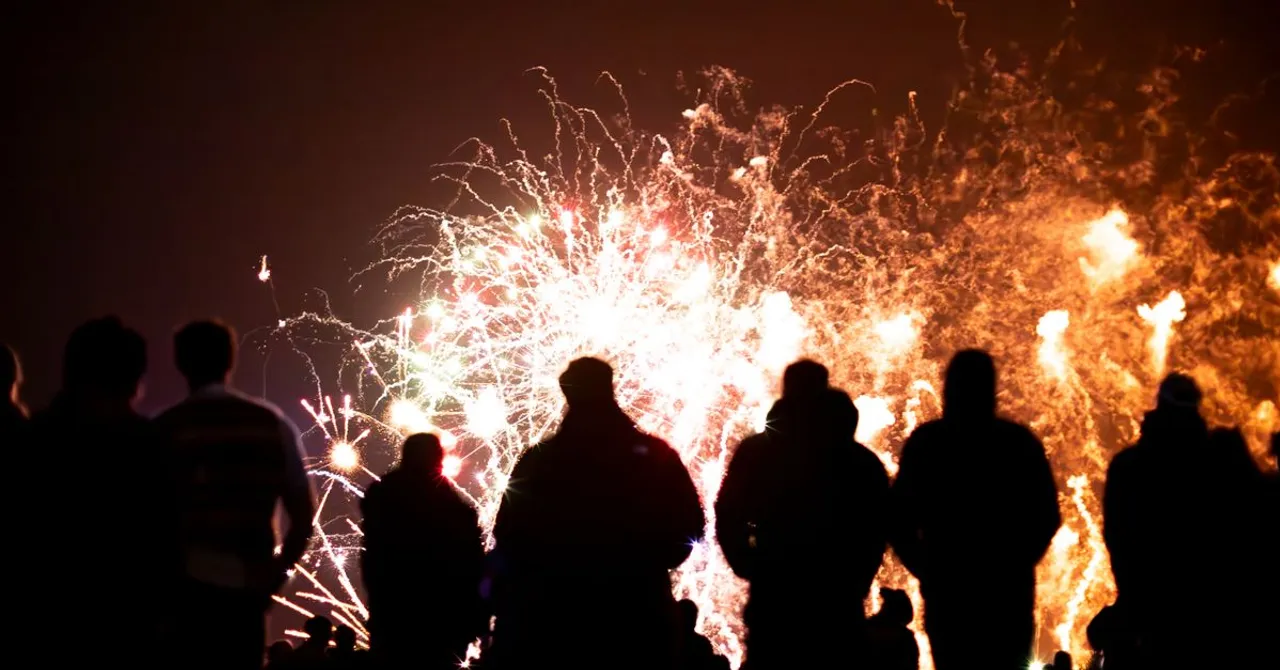
Because signal bars measure how clearly your phone hears the nearest mast, not how many people are sharing it. At fireworks, stadiums and Christmas markets thousands of phones queue for the same cell, and the upload side, built for roughly a tenth of the download traffic, fills first. Send less, move away, and prepare offline.
Contents
- Why do I have full bars but no internet in a crowd?
- Why a crowd filming the same fireworks jams the upload first
- What carriers bring in for big nights, and why it is still not enough
- Are roaming visitors pushed to the back of the queue?
- Can a travel eSIM get you signal when the crowd cannot?
- Before you go: ten minutes of offline prep
- In the crowd: what actually gets a message through
- Will tap-to-pay and phone tickets work when the network is down?
- Crowd calendar: late November 2026 to April 2027
It happens at the exact moment you want your phone most. The countdown hits zero, the sky lights up, and the video you are sending home spins forever under four bars and a confident 5G. Nothing is broken: a shared resource is running out, and once you know which part runs out first, the workarounds stop being guesswork.
Why do I have full bars but no internet in a crowd?
The bars are a reading of signal strength: how loud and clean the nearest mast sounds from where you stand. They say nothing about how many other phones are talking to that same mast, or how much room is left for yours.
That room is finite. Each mast is split into sectors, and each sector has a fixed slice of spectrum that everyone inside it shares. Telefónica's engineers put it plainly in a February 2025 explainer on large events: spectrum is a limited physical resource, and at an event a large number of people try to connect in the same place at the same time.
They add a detail most guides skip: data is not the only thing competing, because signalling and voice compete too. Signalling is the background chatter a phone needs just to stay attached and ask for a turn, so in a dense enough crowd even the asking gets slow.
Full bars in a crowd mean the mast is close and loud. They do not mean it has time for you. A phone with two bars at the edge of the crowd can be faster than one with five in the middle of it.
Why a crowd filming the same fireworks jams the upload first
This is why sending fails before browsing does. Mobile networks are built for download, because most of the time people are watching and reading, not posting.
The network equipment maker Ericsson wrote in March 2026 that most networks cater for 10:1 download-to-upload traffic volumes. Networks are planned around that ratio, so a crowd that suddenly sends far more than usual is asking for traffic they were not dimensioned for.
Then a crowd does the opposite of normal. In its November 2023 Mobility Report, Ericsson recorded a major stadium event where 35 percent of the traffic was upload, driven by people sharing what they were watching.
New Year's Eve shows the same shape at national scale. Deutsche Telekom reported on 2 January 2026 that uploads in the first hour of the new year ran twice as high as on a normal night, with almost half the night's 12 million calls packed between midnight and 1 a.m.
So what breaks first is not the map or the messages coming in. It is the photo, the story and the video call going out, from ten thousand phones pointed at the same sky in the same ten minutes.
What carriers bring in for big nights, and why it is still not enough
Operators do plan for this. Telefónica describes permanent antenna systems inside stadiums and, for outdoor events, trucks carrying antennas and radio equipment. Vodafone UK counted nearly 100 of these cells on wheels sent to UK events between June and August 2025 alone.
Stadiums show what a purpose-built system can carry. Verizon said its customers used 40.32 TB of data in and around Levi's Stadium on Super Bowl Sunday in February 2026, against 7 TB at the same venue in 2016.
A town square is not a stadium. A Christmas market or a harbour foreshore mostly relies on the masts that already cover it, plus whatever temporary capacity each operator decided was worth sending, and you cannot tell which operators bothered from the bars.
Are roaming visitors pushed to the back of the queue?
Possibly, and nobody publishes enough to say for certain. What is documented is that networks rank their own customers when a cell is full.
T-Mobile's network management policy says it prioritises data by plan and brand, so some customers are served before others where the network is heavily loaded. The same page states that it does not describe the practices that apply on roaming partner networks.
How a network ranks visiting phones is set in private roaming agreements, and we have not found an operator that publishes it. Be wary of any claim either way, including one that a particular eSIM gets you to the front. A travel eSIM is not a priority pass.
Can a travel eSIM get you signal when the crowd cannot?
No. A travel eSIM rides the same local towers as everyone standing next to you, so when the sector over Nuremberg's Hauptmarkt is full, it is full for your eSIM too.
What it changes is choice and cost. Many of our plans can use more than one local network in a country, and if one is saturated, another may be merely busy. Which mobile network does your travel eSIM use abroad? shows where each destination lists them.
Retrying a failed video ten times on home roaming can cost real money for nothing delivered; on a prepaid data plan it costs a few megabytes. The eSIM is data only, with no phone number, so for SMS and calls you still rely on your home line.
Before you go: ten minutes of offline prep
The most reliable fix for a jammed network is not needing it. Do these on hotel Wi-Fi before you leave for the event:
- Put every ticket and QR code where it opens without a connection: Apple Wallet, Google Wallet, or at least a screenshot. An app that fetches a fresh code when you open it needs data at the gate, when the gate is busiest.
- Download offline maps for the area, including the walk back to your hotel.
- Screenshot the meeting point and agree a fallback in words: "if we lose each other, the fountain at 12:30". A plan that needs a message to activate fails exactly when you need it.
- Charge the phone and carry a power bank. A night of retries, photos and cold air drains a battery faster than you expect.
Our offline prep checklist covers the full list of apps and files worth downloading before any trip.
In the crowd: what actually gets a message through
Work down this list in order. The first three cost nothing and clear most cases.
- Send a text, not a video. A short chat message needs a sliver of the upload lane, so it can slip through a gap a 30-second clip never will.
- Stop your phone competing with you. Pause photo auto-upload, and switch on Low Data Mode or Data Saver so apps stop refreshing in the background.
- Wait for the peak to pass, or walk. The countdown and the minutes after it are the worst, and a few hundred metres can put you in a different sector.
- Toggle airplane mode on for ten seconds, then off, to drop a stuck connection and ask for a fresh one.
- If your plan lists more than one network in that country, turn off automatic selection and try each for a minute.
- Use venue Wi-Fi if there is any. Stadiums often have it; street markets and fireworks foreshores rarely do.
- Try 5G if you have fallen back to 4G, or the reverse. 5G has more room where the venue invested in it, but a busy 5G cell is still busy.
Slow everywhere, not just in the crowd? That is a different problem, covered in Why is my eSIM data slow abroad?, and Low Data Mode and Data Saver, explained shows exactly what those switches pause.
Will tap-to-pay and phone tickets work when the network is down?
A contactless payment is approved over the card terminal's connection, not yours. The catch is that a market stall's terminal is often on the same mobile network as the crowd: Vodafone gave 102 bar tills at Glastonbury 2024 their own reserved slice of the network so festival traffic could not slow them.
Neither Apple's nor Google's wallet help pages promise that phone payments work with no connection at all. Carry the physical contactless card as well, and some cash for stalls whose reader gives up.
Tickets are the bigger risk. London's New Year's Eve fireworks are ticket-only, and the main booker may be asked for photo ID at the gate. A ticket that lives only inside an app you cannot open is the one case where a jammed network costs you the whole evening.
Crowd calendar: late November 2026 to April 2027
These are the dates when a phone abroad is most likely to meet a full cell. Every date comes from the organiser or a government source, checked in September 2026.
| Event | Dates | When the network is busiest |
|---|---|---|
| Vienna Christmas Market, Rathausplatz | 13 Nov – 26 Dec 2026 | Evenings and weekends; closes 6:30 p.m. on 24 Dec |
| Nuremberg Christkindlesmarkt | 27 Nov – 24 Dec 2026 | Opening ceremony, 27 Nov at 5:30 p.m. |
| Sydney Harbour New Year's Eve | 31 Dec 2026 | Fireworks at 9 p.m. and midnight |
| London New Year's Eve fireworks | 31 Dec 2026 | Ticketed, 8 p.m. to 12:30 a.m. |
| Shibuya, Tokyo | 31 Dec 2026 | Official countdown cancelled for 2025–26; 2026–27 not yet announced |
| Lunar New Year | 6 Feb 2027 | Eve and first day; Hong Kong holidays 6, 8 and 9 Feb |
| Rio Carnival, Sambadrome parades | 7–9 Feb 2027 | All three parade nights |
| Holi, India | 22–23 Mar 2027 | Daytime street celebrations; the date varies by state |
| Songkran, Thailand | 13–15 Apr 2027 | Daytime, in the water-fight streets |
The markets run for weeks, so they are thin on a Tuesday lunchtime and packed on a Saturday night. Nuremberg's opening evening, Friday 27 November, is the one to expect a jammed network. Plans for the season are on the Germany destination page.
Sydney runs two displays, and the City of Sydney's viewing guide warns that most vantage points do not allow re-entry once you leave. Settle your meeting point before you go in. Plans are on the Australia destination page.
In Tokyo, Shibuya City announced on 3 December 2025 that the organised countdown was cancelled, and fenced off the Hachiko statue from 6 a.m. on 31 December. People gather at the crossing anyway, so expect the crowd without the organisation. See the Japan destination page.
The first weekend of February 2027 stacks two huge crowds: Lunar New Year's Day on Saturday 6 February, and Rio's Special Group parades on 7, 8 and 9 February, per the league that stages them. Rio plans are on the Brazil destination page.
At Songkran, 13 to 15 April 2027, the water is a bigger threat to your phone than the crowd, so a waterproof pouch matters as much as offline tickets. The Thailand destination page lists the local networks.
Check which networks your destination uses →Why does my phone show full bars but nothing loads at a concert?
Bars measure signal strength, not free capacity. The mast is close and loud, but thousands of phones share its fixed slice of spectrum, and the upload side fills first. Send smaller things, pause auto-uploads, and try again after the peak.
Will a travel eSIM work better than my home SIM in a crowd?
Not on the same network. It uses the same local towers as everyone around you. It helps when your plan lists more than one local network, because you can switch to a less busy one, and it avoids roaming charges on every failed retry.
Do roaming phones get lower priority than local customers?
Possibly, but it is not published. Carriers such as T-Mobile document ranking their own customers by plan when a cell is heavily loaded, and say those rules do not cover roaming partner networks. How visitors are ranked sits in private agreements.
Why do messages go through when videos will not?
Size. A text needs a tiny amount of upload capacity and can squeeze through a brief gap, while a video needs a sustained stream of it. The upload lane is exactly what runs out at a crowded event.
Does Apple Pay or Google Wallet work with no signal?
A tap payment is approved over the terminal's connection rather than your phone's, but neither Apple nor Google promises offline payment in its help pages, and a stall's terminal may be on the same jammed network. Carry the physical card and some cash.
How far do I need to walk to get data back?
Often a few hundred metres, because that can put you in a different sector of the mast or under a different mast. Moving away from the densest point, like the front of a stage, helps more than moving within it.
Will my phone work again after midnight on New Year's Eve?
Usually within the hour. Telekom's figures for the night of 2025 to 2026 show uploads at twice their normal level in the first hour of the new year. Once people stop posting and start walking home, the cells clear.