Why did my unlimited eSIM data slow down?

Almost always fair use, not a fault. Unlimited eSIMs give a full-speed data allowance each day, and once you use it, speed drops until the allowance refreshes, 24 hours after activation, not at local midnight. Fast earlier today and slower now? This is almost certainly why.
Contents
It’s a strange kind of relief and confusion at once: your unlimited eSIM was flying an hour ago, and now pages crawl. Before you assume something broke, know this: it’s the single most common thing people write in about with an unlimited plan, and it’s very rarely the eSIM itself. Here’s exactly what’s happening, when your allowance comes back, and how to tell if this really is something else.
It’s fair use, not a fault
Unlimited on a travel eSIM means you get data for your whole trip with no total bucket to run dry, not an endless firehose of full speed. Every day includes a high-speed allowance (the exact amount varies by plan and destination, so check your plan’s own details for the number). Once you use it, you don’t get cut off, you stay connected at a reduced speed for the rest of that day, still fine for maps, messaging and email, until the next allowance kicks in. Our guide to what unlimited really means covers the fine print if you want the full picture; this one is about recognizing the pattern and knowing when to stop worrying.
Fair-use limits like this aren’t a trick to get around the word “unlimited”, they’re how unlimited stays viable everywhere, on a travel eSIM or on the plan you use at home. Even regulators building consumer-friendly rules bake them in: the EU’s own guidance on roaming costs confirms operators can apply a fair-use policy with data caps on unlimited-labelled roaming contracts under its roam-like-at-home rules. If a regulator writing pro-traveler rules allows for it, it’s a normal, expected part of how “unlimited” works, not something specific to one plan or provider.
When does it actually reset? Not at midnight
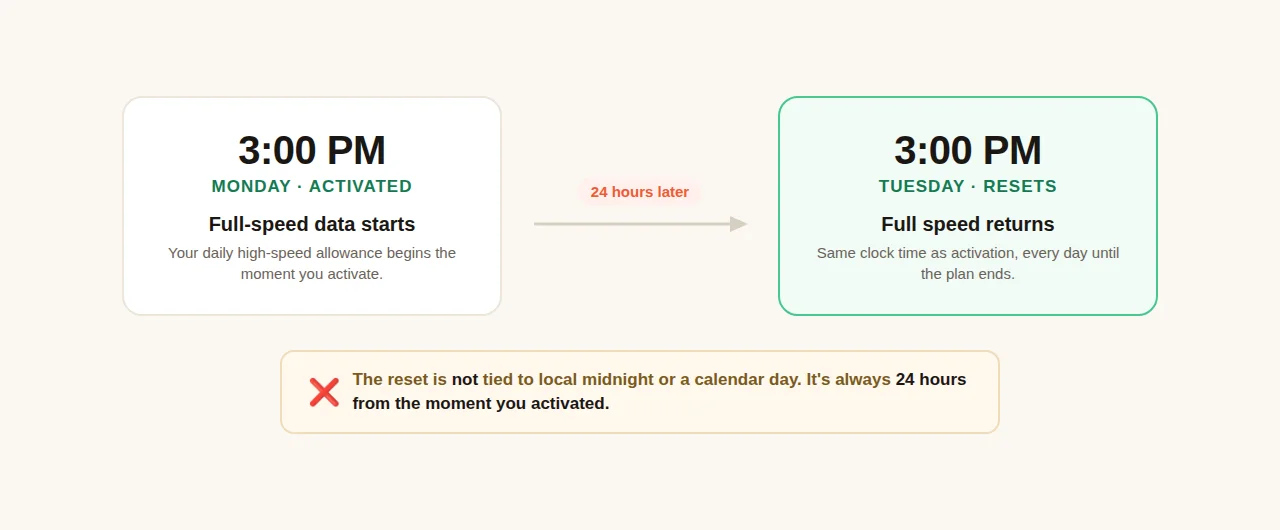
Here’s the part that catches almost everyone out: the daily allowance doesn’t reset at local midnight, or at any fixed clock time at all. It resets 24 hours after you activated the eSIM, and then every 24 hours after that until the plan ends.
Activate at 3 pm on Monday and your allowance refreshes at 3 pm on Tuesday, 3 pm on Wednesday, and so on for the rest of the plan. That also means two travelers on the same kind of plan can reset at completely different times, because it tracks each person’s own activation moment, not a shared calendar day.
How to tell if this is what’s happening to you
- Was it fast earlier today, and only slowed down later? That’s the classic pattern.
- Check when you activated the eSIM (your account shows this on the plan’s page) and count roughly 24 hours forward from that time.
- Are maps, messaging and email still working, just slowly, rather than not at all? Throttling never cuts the connection, it only slows it.
- Has it happened on previous days of the same trip, around the same time each day? A repeating daily pattern all but confirms it.
One mix-up worth ruling out first: your phone’s own data counter has a manual “Reset Statistics” button of its own (Settings → Cellular on iPhone, Settings → Network & internet on Android), and that’s completely separate from your plan’s automatic daily reset. Tapping it just zeroes out the on-screen tally; it doesn’t touch your actual allowance or bring back full speed. Apple’s guide to cellular data and Google’s Pixel data usage guide both cover this counter, treat it as a rough log, never the source of truth for your plan.
Nothing to do here. The connection is working exactly as designed, and full speed comes back on its own at your next reset, no reinstall, no support ticket and no data lost.
What the reduced speed still lets you do
Reduced speed is a deliberate slowdown, not a data cut-off, so what you can still do depends on the exact speed your plan drops to (check the plan’s own details, it’s usually printed as a kbps or Mbps number). Chat apps, email and a map that’s already loaded a route keep working at almost any tier; video and big downloads are what suffers first. Our breakdown of what every speed from 128 kbps to 5 Mbps actually feels like translates the number on your plan into what you’ll actually notice, but as a rough guide:
| Usually still fine | Usually struggles |
|---|---|
| Messaging, email, voice notes | Video streaming |
| Maps, once the route has loaded | Large downloads and app updates |
| Basic browsing, text-heavy pages | Photo or video uploads |
| Music streaming at standard quality | Video calls and group calls |
When it’s something else
If the slowdown doesn’t match that pattern, if it’s been slow all day since you landed, or it’s on and off rather than a clean before/after split, it’s worth ruling out a different cause before blaming the daily allowance:
- Slow everywhere, all day, since you landed: more likely your phone latched onto a busy local network. Manually picking a different one is usually the fastest fix.
- Fine on Wi-Fi, slow specifically when streaming: check whether Low Data Mode or Data Saver is switched on for your travel eSIM’s line.
- No connection at all, not just slow: that’s a different problem with a different fix, covered in our eSIM won’t connect guide.
- You’ve genuinely burned through a huge amount of data, streaming or a big hotspot session: check your usage to see whether the daily allowance is the likely cause.
Most of the time, though, it really is the simplest explanation: you used the day’s high-speed data, and full speed is back at the same time tomorrow. If you’re consistently hitting the reduced speed before the day is out, it’s worth sizing your next plan’s daily allowance a little more generously so you don’t wait it out again.
Is a slowdown a sign my unlimited eSIM is broken?
Almost never. It’s the single most common thing people write in about with an unlimited plan, and it’s nearly always the day’s high-speed allowance being used up, not a fault with the eSIM.
Will it happen again tomorrow?
Only if you use that day’s full-speed allowance again. Either way, the reset happens 24 hours after activation on schedule, so full speed always comes back.
Why did my allowance reset at a different time than my friend’s?
Because it’s tied to each person’s own activation moment, not a shared clock. Two people who activated an hour apart will reset an hour apart too.
Can I pay to get full speed back sooner?
No, the daily allowance simply refreshes on its own 24 hours after activation. A top-up adds days to the plan, it doesn’t change today’s allowance or speed up the reset.
Does the reduced speed use up my data differently?
No. Unlimited means there’s no total data bucket either way, full speed or reduced. The only thing that changes is how fast that data moves.
How do I know what speed I’ll drop to?
It’s stated on your plan’s own details, commonly somewhere between 128 kbps and 1 Mbps. Our guide to what every speed actually feels like translates the number into what you’ll notice.


