Looking for an eSIM for the USA? Zwitchy's USA eSIM connects on AT&T, with 5G where available, and installs at home before you fly. It's data-only, so calls and texts go through WhatsApp, FaceTime or your home line. Take 10 GB for a week, 20 GB for a two-week road trip, or unlimited if you hotspot daily.
The United States is a destination where almost everything runs through your phone: the rideshare from the airport, the subway gate in New York, the hotel booking and the restaurant waitlist. It's also big enough that one trip can move from dense city 5G to national park valleys with no signal at all. This guide covers which network you're on, where coverage really ends, what to do about calls and texts on a data-only plan, and which plan to buy. For a GB-by-GB budget, see how much data you need in the USA.
Why a travel eSIM is the best option for the USA
In short: Cheaper than roaming, no store hunt on arrival day, and your own SIM stays in for bank codes.
You have three ways to get online: roam on your home plan, buy a US prepaid SIM after you land, or install a travel eSIM before you fly. Roaming is usually the priciest per gigabyte, and daily passes add up over a two-week trip. A prepaid SIM from AT&T, T-Mobile or Verizon is fair value, but it means finding a store on arrival day, jet-lagged, before you can even call a ride. A travel eSIM installs at home over Wi-Fi, connects as soon as you land, and leaves your own SIM in place for bank codes and calls. Weighing it up? See eSIM vs local SIM vs roaming.
TipAdding Canada or Mexico? A USA plan only works in the United States. Zwitchy's North America plan covers the US, Canada and Mexico on one eSIM, so a Seattle to Vancouver drive or a San Diego day trip across the border stays on a single plan.
Which network your USA eSIM uses
In short: You're on AT&T, with 5G where it exists. Its 99% figure counts people, not land.
Zwitchy's USA eSIM connects on AT&T, with 5G where it's available and 4G LTE elsewhere. There's nothing to pick by hand: switch on Data Roaming for the eSIM line and your phone joins AT&T when you land. AT&T says it covers more than 99% of the US population, with 5G reaching over 316 million people. Both numbers count people, not land, and that difference is the whole story of a US road trip.
In cities, suburbs and the busy highways between them, you'll rarely think about signal. The gaps are where few people live: mountain passes, desert highways, deep canyons and protected wilderness. Before a remote drive, look up where you're heading on AT&T's coverage map. It shows approximate outdoor coverage, so expect a little less inside buildings and cars.
Is there cell service in the national parks?
In short: Signal clusters around lodges and visitor centers; Death Valley has none on most roads.
Often not much, and partly by design. The National Park Service says cell service varies from park to park, and that breaks can happen even in areas that look covered on a provider's map. Signal clusters around lodges, villages and visitor centers, then falls away on the trails and back roads.
Coverage maps count people, not canyons, and the empty places are often the reason you came.
Yellowstone says cellular service in the park is extremely limited and texting is usually the most effective way to communicate; free public Wi-Fi is available at the Albright, Old Faithful and West Yellowstone visitor centers. Yosemite's own list shows AT&T voice and 4G LTE data in Yosemite Valley and at Glacier Point, mostly in the eastern part of the valley, and no cell service at Tuolumne Meadows. There's free Wi-Fi at Degnan's Kitchen in Yosemite Village.
Heads-upDeath Valley is the one to take seriously. The park says there's no cell phone service along most park roads, and GPS navigation to remote places like Death Valley is notoriously unreliable. Carry a paper map, and stick to the paved roads you planned instead of following a phone shortcut.
Road trips: how to plan around the dead zones
In short: Download offline maps before each leg and send short messages when the signal is weak.
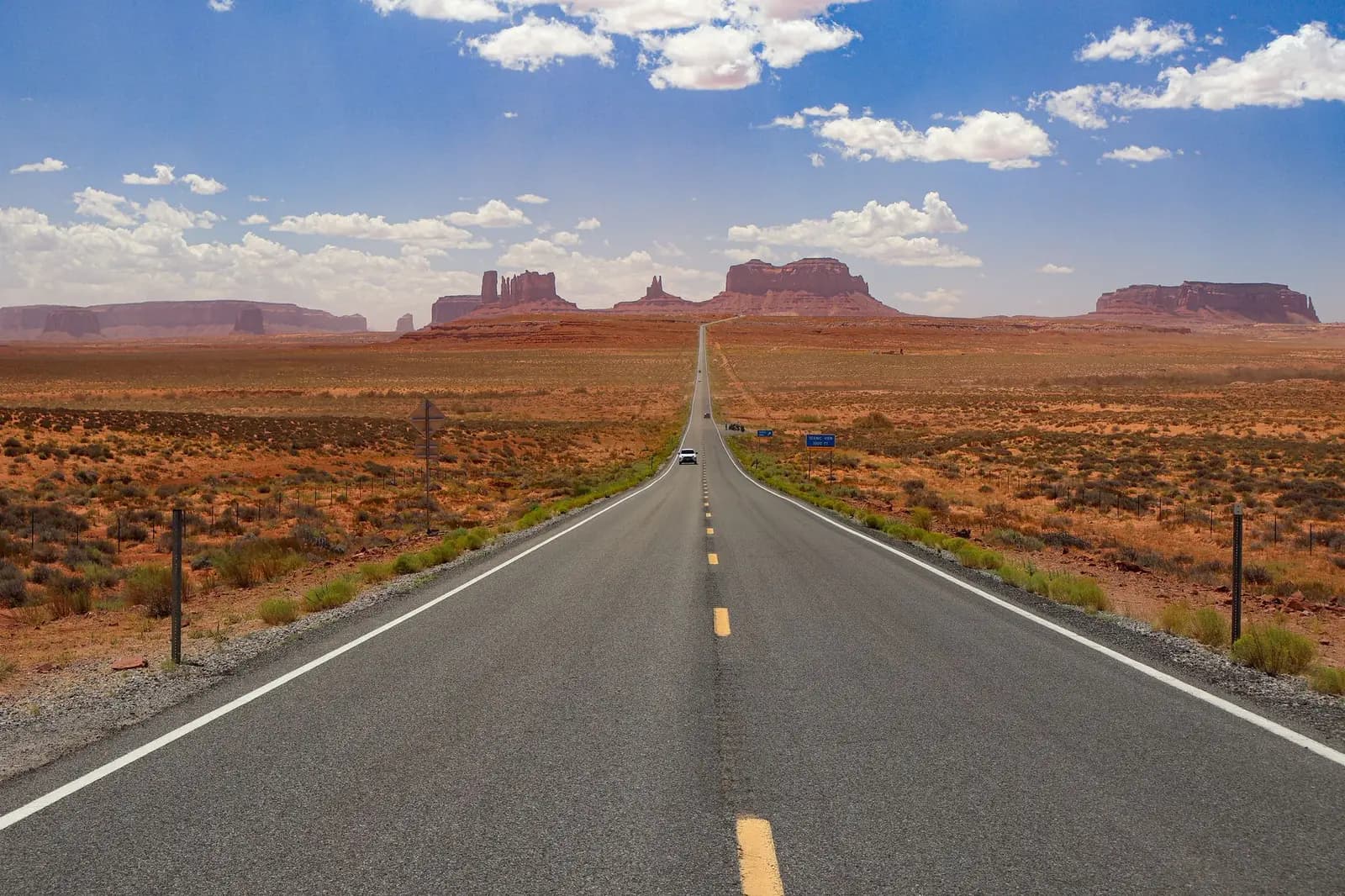
A drive through Utah and Arizona or along the California coast will cross stretches with no signal for any phone. That's terrain, not your plan. A few habits keep it from mattering:
- Before each leg, download offline maps for the whole route while you're still on hotel Wi-Fi or a strong signal.
- Save hotel confirmations, park reservations and rental-car details as screenshots or offline files.
- Tell someone your route and when you expect to be back in range, especially before a hike.
- In weak signal, send a short message rather than trying a call or video: Yellowstone itself says texting is what gets through best.
Data use climbs on a road trip too, with navigation running all day and passengers streaming in the back. Our USA data guide works out the numbers, and the offline prep checklist covers what to download before you set off.
Calls and texts: is there a USA eSIM with a phone number?
In short: Data-only, no US number: call over WhatsApp or LINE, and keep your home SIM on for texts.
Not from Zwitchy. Our USA eSIM is data-only, so it has no US phone number and doesn't send ordinary SMS. For most visitors that's fine: WhatsApp, LINE, FaceTime and Messenger calls all run over data, and Uber, Lyft and most US apps work with the account you already have.
Keep your home SIM switched on next to the eSIM, with its data roaming off, so bank codes and texts still reach your usual number; your home carrier may charge for roaming calls and texts, so check its rates. If your carrier supports Wi-Fi Calling, you may be able to call on your own number over hotel Wi-Fi too; ask before you fly whether it works abroad. The setup is in keeping WhatsApp, iMessage and your number on a travel eSIM.
Need a real US number, for a landlord, a job interview or people in the States who'll ring you? Then you want a US carrier's prepaid plan with talk and text. T-Mobile, for example, launched a U.S. Pass eSIM for international visitors in May 2026 with unlimited talk and text.
Arriving in the USA: the first hour
In short: Install at home, then turn on the eSIM and Data Roaming once you're through immigration.
Install the eSIM at home on Wi-Fi, it doesn't start the clock. Depending on your passport, you'll need an approved ESTA under the Visa Waiver Program or a US visa before you board. Once you're through immigration at LAX, San Francisco (SFO), New York JFK or wherever you land, set Zwitchy as your data line and switch on Data Roaming for it (that just means "use AT&T through the eSIM," never your home carrier). If something needs fixing, LAX has free Wi-Fi in the public areas of all terminals.
Getting online fast matters because so much here is app-first. Airport rideshare pickups run through Uber and Lyft, and in New York you can tap a contactless card or your phone to ride the subway and buses with OMNY. Neither needs a US number.
Is your phone ready for a US eSIM?
In short: Any carrier-unlocked, eSIM-capable phone works on AT&T.
Any eSIM-capable phone works on AT&T: iPhone XS / XR or newer, Google Pixel 3 and up, and recent Samsung Galaxy flagships. Two catches: the phone must be carrier-unlocked, and it's worth checking Settings → General → About for an EID before you rely on it. The eSIM runs alongside your physical SIM, so you keep your home line for calls and texts and pick Zwitchy for mobile data.
Which USA plan to buy
In short: Take 10 GB for a week, 20 GB for a two-week road trip, and unlimited if you hotspot daily.
Every USA plan with a set amount of data lasts 30 days, in 1, 3, 5, 10, 20, 30 or 50 GB. Unlimited plans run for 3, 5, 7, 10, 15, 20, 25 or 30 days, and a 100 MB plan covers a single day. All of them are prepaid and data-only. Match one to your trip:
- A layover or one day in transit: the 100 MB one-day plan covers messages and a few map lookups.
- A long weekend in New York, Los Angeles or Las Vegas: the 3 GB plan, or 5 GB if you post a lot.
- A week in one or two cities: the 10 GB plan.
- Two weeks with a road trip, or passengers streaming: 20 GB or bigger.
- Daily hotspotting or remote work: an unlimited plan for the exact number of days, with full speed for the first 3 GB each day and slower speed after that.
Want one pick? Take 10 GB for a week and 20 GB for a two-week road trip, both valid for 30 days, and top up in seconds if you run low. Not sure how much you'll use? How much data you need in the USA breaks it down by trip type. Crossing into Canada or Mexico too? Read our Canada and Mexico guides, or cover all three on one North America plan.
Questions travelers ask
Which network does a USA eSIM use?
Zwitchy's USA eSIM connects on AT&T, with 5G where it's available and 4G LTE elsewhere. Turn on Data Roaming for the eSIM line and your phone joins AT&T automatically when you land.
Is there a USA eSIM with a phone number?
Zwitchy's USA eSIM is data-only, with no US number. Calls and messages work through WhatsApp, LINE or FaceTime, and your home SIM can stay on for texts. If you need a real US number, get a prepaid plan with talk and text from a US carrier.
Is there an unlimited eSIM for the USA?
Yes. Zwitchy's unlimited USA plans run for 3, 5, 7, 10, 15, 20, 25 or 30 days, with full speed for the first 3 GB each day and slower speed for the rest of that day.
How much does a USA eSIM cost?
It depends on the size: plans run from 100 MB for one day to 50 GB for 30 days, plus unlimited plans by the day. Current prices are on the USA plans page, and you pay once, with no contract.
Will my eSIM work in Yellowstone, Yosemite or Death Valley?
Only where there's a signal. Yellowstone calls its cell service extremely limited, Yosemite has AT&T 4G LTE mainly in eastern Yosemite Valley and at Glacier Point, and Death Valley has no service along most park roads. Download offline maps before you drive in.
Does one eSIM cover the USA, Canada and Mexico?
A USA plan works only in the United States. For a trip that crosses a border, Zwitchy's North America plan covers the US, Canada and Mexico on one eSIM.
Can I install the USA eSIM before I fly?
Yes, and you should. Install it at home over Wi-Fi, then switch it on and turn on Data Roaming for it after you land. Installing doesn't start the plan.
Sources
Written by the Zwitchy team. Updated Oct 28, 2026.
- covers more than 99% of the US population, with 5G reaching over 316 million people · att.com
- AT&T's coverage map · att.com
- cell service varies from park to park, and that breaks can happen even in areas that look covered on a provider's map · nps.gov
- cellular service in the park is extremely limited and texting is usually the most effective way to communicate · nps.gov
- AT&T voice and 4G LTE data in Yosemite Valley and at Glacier Point, mostly in the eastern part of the valley, and no cell service at Tuolumne Meadows · nps.gov
- there's no cell phone service along most park roads, and GPS navigation to remote places like Death Valley is notoriously unreliable · nps.gov
- offline maps · support.google.com
- Wi-Fi Calling · support.apple.com
- launched a U.S. Pass eSIM for international visitors in May 2026 · t-mobile.com
- ESTA · esta.cbp.dhs.gov
- Visa Waiver Program · travel.state.gov
- free Wi-Fi in the public areas of all terminals · flylax.com
- tap a contactless card or your phone to ride the subway and buses with OMNY · omny.info
Get a travel eSIM for 200+ destinations in under a minute.
Get your United States eSIM →