Phone on a cruise: at sea, in port, near borders
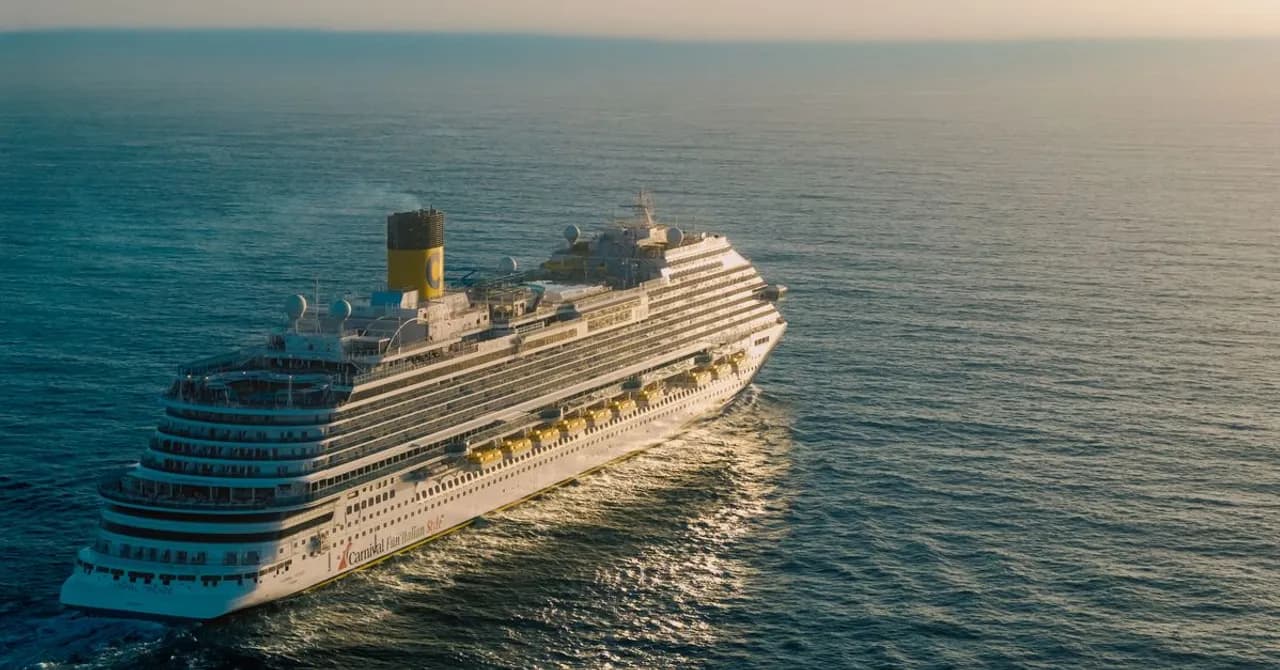
On a cruise your phone meets three networks. At sea it can join the ship's own cell network, billed by your home carrier at cruise rates. In port it uses a local network. Near borders it may pick a neighbouring country's. Keep home-line data roaming off, use ship Wi-Fi at sea and a travel eSIM in port.
Contents
- Three networks on one cruise
- At sea: the ship's own network
- What a travel eSIM does at sea
- In port: a local network, so pick plans by port
- Near borders: when your phone picks the neighbour's network
- Why a travel eSIM can't bill you at the border
- How to pick the network yourself
- Before you sail: the checklist
A cruise is the one holiday where your phone changes country without you noticing. Overnight the ship sails from one port to the next, and in between your phone may join a network that belongs to no country at all. On a coastal stretch it can hop to the wrong side of a border that is just a few kilometres of water away.
None of this is a reason to leave the phone at home. It is a reason to know which network you are on at each point of the trip, and who sets the price there. This guide walks through the three situations, what a travel eSIM does in each, and the settings that keep the bill at zero surprises.
Three networks on one cruise
| Where the ship is | What your phone connects to | Who sets the price |
|---|---|---|
| Open sea, beyond 12 nautical miles | The ship's own cell network, linked to land by satellite | Your home carrier, at its cruise or maritime rates |
| Docked in port | A local network in that country | Your home carrier's roaming rates, or your travel eSIM |
| Sailing close to a coast or border | Whichever land network is strongest, even across a border | The rates of the country that network belongs to |
| Anywhere on board | The ship's Wi-Fi | The cruise line, per package |
The rest of this guide takes them one at a time. The short version: the ship's network is the expensive one, the port is where a travel eSIM earns its keep, and the coast is where you need to watch the network name.
At sea: the ship's own network
Larger cruise ships carry their own mobile network: a small cell on board, linked to the shore by satellite. It is switched off near land and comes on once the ship is out at sea. Norwegian Cruise Line states the rule plainly.
Onboard cellular services are available only in international waters (12 nautical miles or more away from shore).
The cruise line does not decide what you pay on that network. Royal Caribbean says its roaming rates "are determined by your cellular provider", and NCL says the charges appear on your regular phone bill at home. So the question to ask before you sail is not the cruise line's, it is your own carrier's: what does a day on a ship cost on my plan?
Some carriers sell a cruise pass. Verizon's Cruise Daily Pass is US$20 per line for a 24-hour session, charged only on days you use service on board, and Verizon notes that the ship's cellular service turns on 12 miles after leaving the dock. Without a pass you pay your carrier's maritime rates, which are not your normal roaming prices. Vodafone in the Czech Republic, for example, bills onboard ship networks at its Zone 3 rates, not the EU ones.
EU plans get no shelter here either. The European Commission is explicit that roam-like-at-home stops at the shoreline's networks.
EU roaming rules apply only to terrestrial mobile networks.
The same page says these services are usually expensive, that you should get a free text with the prices when your phone joins such a network, and that mobile data stops automatically once you reach €50 of extra charges or another preset limit. It also confirms the good news for river cruises: as long as your phone is connected to a normal land network, on a river, a lake or along the coast, your EU allowance still applies. Our guide to where your EU roaming actually stops covers the regulation in detail.
The €50 cut-off is for data. A call you answer or make on the ship's network is billed on top, so if you want to stay reachable at sea, do it over Wi-Fi rather than the ship's cell.
What a travel eSIM does at sea
Nothing, and that is useful. Zwitchy plans cover land networks in the countries listed on each plan. The ship's network is not one of them, so out at sea the eSIM simply shows no service. Because every plan is prepaid, it also cannot run up a bill: there is no rate it could charge you at sea, high or otherwise.
Your home SIM is the one to think about. With its data roaming switched off it will not use data on the ship's network, but it can still make and receive calls and texts there, which your carrier may bill at cruise rates. If you don't need your number at sea, the safest setting is airplane mode with Wi-Fi switched back on. If you do, Wi-Fi Calling can carry calls and texts over the ship's Wi-Fi instead, where your carrier supports it. Our guide to SMS codes abroad explains when that works.
For data at sea, the ship's Wi-Fi is the realistic option. Big lines sell it in packages, usually per device, by the day or for the whole voyage. Check what each package allows before you pick, because video can need a separate tier: NCL sells a Streaming Voyage Wi-Fi pass for it, and says it has partnered with Starlink for its Wi-Fi.
In port: a local network, so pick plans by port
Once the ship is alongside, the onboard network is off and your phone joins a local network like any visitor's would. Verizon's terms put it in one line: in port or in an area served by a foreign wireless carrier, you are billed at the rates for that country. That is where a travel eSIM does its work, as long as the port's country is on your plan.
A port day is usually light on data: maps to the old town, a few messages and photos home, a ride back to the ship. Most sightseeing days use 150 MB to 300 MB. The planning question is coverage, not volume, because cruise itineraries cross more countries in a week than most trips do in a month.
| Typical itinerary | What covers every port |
|---|---|
| Eastern or Southern Caribbean on the 11 islands of the regional plan | One Caribbean plan |
| Western Caribbean with Cozumel, Belize or Honduras | A Mexico plan plus a Central America plan, or a country plan per stop |
| Mediterranean: Spain, France, Italy, Greece, Croatia, Malta, Montenegro, Albania | One Europe plan |
| Mediterranean with Turkey, Gibraltar, Morocco or Tunisia | A Global plan, or Europe plus a country plan for each extra port |
| Norwegian fjords, Iceland, the Baltic or the British Isles | One Europe plan |
| Alaska and the Inside Passage | One North America plan (US, Canada, Mexico) |
Check the full port list before you buy, not the region in the brochure. Some popular stops, including Sint Maarten, Aruba and the US Virgin Islands, are not on any Zwitchy plan today, and Gibraltar is outside the Europe plan. Install everything at home over Wi-Fi: a cruise terminal or a pier is a bad place to find out the QR code needs a connection you don't have.
Near borders: when your phone picks the neighbour's network
This is the one that catches people who did everything else right. A phone on automatic network selection joins whichever signal it rates best. Close to a border, across a narrow strait or just offshore, that can be a tower in the next country, even though you never left the beach or the deck.
Your phone may connect to a network from a neighbouring country even if you have not physically crossed the border.
On a home SIM, that means paying the neighbour's roaming rates. Cruises are especially exposed, because ships sail along coasts and anchor in sight of other countries. These are the well-known spots.
| Where you are | Network your phone may join | Why it matters |
|---|---|---|
| Lesbos and the eastern Greek islands | Turkish networks across the strait | Turkey is outside EU roaming. Europe's consumer centre in the Netherlands warns Lesbos visitors about exactly this |
| Corfu | Albanian networks across the Corfu strait | Albania is outside EU roaming. UK carriers' help forums carry complaints from Corfu visitors billed for Albania |
| Northern Cyprus and near the Green Line | Turkish operators' networks | Vodafone Czech Republic names it as a known risk |
| Saint-Martin and Sint Maarten | The other half of the island | The French north is inside EU roaming, the Dutch south is not, and the border is an open road |
| St John and St Thomas, US Virgin Islands | British Virgin Islands networks | Verizon treats the US Virgin Islands as domestic. The BVI, a short ferry ride away, are international |
| Swiss lakes and the Rhine near Basel | Swiss networks | Switzerland is outside EU roaming, and many plans charge extra there |
Lesbos is the example with an official warning behind it. The European Consumer Centre Netherlands puts it simply: if your phone automatically connects to a Turkish network, you will pay extra for mobile data. Its advice is to ask your provider whether networks outside the EU can be blocked, and to choose which network your phone uses.
On Corfu, the giveaway is a charge for a country you never visited. Threads like this one on Sky's help forum are from customers who stayed on the Greek island and were billed for Albania. In the Virgin Islands it works the other way round for Americans: Verizon's domestic roaming FAQ counts the US Virgin Islands as part of its domestic footprint, so a phone in St John is at home until it locks onto a British Virgin Islands tower across the channel.
Why a travel eSIM can't bill you at the border
A travel eSIM changes what happens at a border in two ways. It is prepaid, so joining the wrong network can never produce a bill. And it only connects in the countries on your plan, so the result depends on the plan you chose.
- If the neighbour is on your plan, nothing happens. A Europe plan covers both Greece and Albania, so a phone on Corfu that drifts onto an Albanian network keeps working and counts against the same data.
- If the neighbour is not on your plan, you may see no service or a connection with no data, even with full bars. A Greece plan on Lesbos cannot use a Turkish network, and a Europe plan does not include Turkey. A Global plan covers both, if your itinerary includes Turkish ports anyway.
- Either way, your home line is still exposed if its data roaming is on. Keep it off, so the only line using data near a border is the one that cannot surprise you.
How to pick the network yourself
The fix for a phone that keeps choosing the wrong country is to choose for it. Switch off automatic network selection on the line that is misbehaving and pick a network from the country you are actually in. Each destination page on Zwitchy lists the networks your plan uses there.
- iPhone: Settings > Mobile Service (Cellular in the US) > choose the line > Network Selection > turn off Automatic, then tap a network.
- Samsung and many other Android phones: Settings > Connections > Mobile networks > Network operators > turn off Select automatically, then pick a network.
- Google Pixel: Settings > Network & internet > SIMs > choose the line, then open the network option to pick an operator by hand. Labels vary with the Android version.
Vodafone's own guide warns that registering on a network by hand can take a few attempts, so give it a minute. Two habits make this painless: glance at the network name next to the signal bars when you dock or anchor close to another country, and switch back to automatic before the next port, or your phone will keep hunting for a network that is no longer there. If your eSIM still shows no service after that, our No Service fix goes through the rest.
Before you sail: the checklist
- Ask your carrier what a day on the ship's network costs, and whether it sells a cruise pass. Get the answer for calls and texts, not just data.
- List every port and check each country is on your plan. Buy a regional or Global plan if the itinerary crosses several, and a country plan for any stop it misses.
- Install the eSIM at home over Wi-Fi and set it as your data line. Setting up your eSIM before you fly takes five minutes.
- Switch data roaming off on your home line and on for the eSIM. Why data roaming should be on for a travel eSIM explains why that is safe.
- Decide on ship Wi-Fi before you board, and turn on Wi-Fi Calling at home if you want your number reachable at sea.
- Download offline maps for every port with our offline prep checklist.
- On board, watch for a text announcing a maritime network, and check the network name whenever land is in sight.
Does my phone work on a cruise ship?
Yes. At sea it can join the ship's own cell network, which your home carrier bills at its cruise rates, and in port it joins a local network. The ship's Wi-Fi works everywhere on board, sold by the cruise line.
Does a travel eSIM work at sea?
No. A travel eSIM covers land networks in the countries on its plan, and the ship's network is not one of them. At sea it shows no service and cannot charge you anything. Use the ship's Wi-Fi for data until the next port.
Will a travel eSIM work in every cruise port?
Only in ports whose country is on your plan. A Caribbean, Europe or Global plan covers most itineraries in one eSIM, but check the full port list, since a few stops, such as Sint Maarten and Aruba, are not on any Zwitchy plan today.
Should I use airplane mode on a cruise?
At sea it is the simplest way to stay off the ship's network. Turn airplane mode on, then switch Wi-Fi back on for the ship's internet. In port, turn airplane mode off so the eSIM can join the local network.
Why was I charged for Albania when I stayed on Corfu?
Your phone joined an Albanian network across the Corfu strait. Albania is outside EU roaming, so a home SIM pays roaming rates there. Choosing a Greek network by hand, or keeping home-line data roaming off, prevents it.
Does EU roaming work on a ferry or cruise ship?
Only while your phone is on a land network, for example near the coast or on a river. Once it joins the ship's satellite-linked network, the EU rules no longer apply and your carrier sets the price.


