Two weeks in the Balkans: Ljubljana to Kotor
Four countries in fourteen nights, running north to south from the Alps to the Adriatic. Two legs are trains and two are buses, because the railway between Croatia and Bosnia has not run since 2016. Budget 500 MB to 1 GB a day, and buy one regional eSIM rather than trusting an EU plan that stops working halfway.
Contents
- The route, leg by leg
- Where your phone stops working like home
- Ljubljana, two nights
- Ljubljana to Zagreb
- Zagreb, three nights
- Zagreb to Sarajevo
- Sarajevo, three nights
- Sarajevo to Mostar
- Mostar, two nights
- Mostar to Kotor
- Kotor, four nights
- How much data two weeks here needs
- Borders, and what they cost you in time
- Before you go
- Booking and official sources
This is the route people mean when they say they are going to the Balkans, and it is the one that catches them out. The first half looks like ordinary European travel: two capital cities, a fast train between them, no border formalities worth mentioning. The second half is a different continent administratively. The trains stop, the buses take over, the borders come back, and the phone in your pocket quietly changes what it costs to use.
None of that makes the trip hard. It makes it worth planning properly, which is what the rest of this is for.
The route, leg by leg
Fourteen nights across five bases and four countries. Two of the four legs are trains and two are buses, and the buses are not a downgrade: on this route they go places the railway simply does not. Times below are indicative and worth rechecking when you book, because border queues move them more than timetables do.
| Leg | How | Time | Nights |
|---|---|---|---|
| Ljubljana | Arrive by air | - | 2 |
| Ljubljana to Zagreb | Direct train, run jointly by SŽ and HŽPP | About 2h10 | 3 |
| Zagreb to Sarajevo | Bus. There is no through train | About 7h to 8h | 3 |
| Sarajevo to Mostar | Train twice daily, or frequent buses | About 2h | 2 |
| Mostar to Kotor | Bus, inland via Trebinje | About 4h30 to 6h | 4 |
Run it the other way if flights home are cheaper from Ljubljana. The connectivity advice below does not change with direction, though the order in which it bites does: going south you get the pleasant surprise first and the expensive one later.
Where your phone stops working like home
This is the part almost every itinerary skips, and it is the single thing most likely to cost you real money on this route.
Slovenia and Croatia are EU member states. If your SIM was issued anywhere in the EU or the EEA, it works in both at your domestic rates under the roaming rules, with no surcharge beyond your operator's fair-use policy. Ljubljana to Zagreb changes nothing about your bill, and the same logic covers the rest of the bloc if you are extending the trip: we walk through it in one eSIM, 39 countries. The Commission's own summary of the roaming rules sets out what your operator may and may not charge you inside that area.
Bosnia and Herzegovina and Montenegro are not in the EU or the EEA, and neither is in the roam-like-at-home area. The moment your bus crosses into Bosnia, your EU plan is roaming in the old sense of the word.
Here is where it gets genuinely confusing, and where a lot of otherwise good travel writing is wrong. You may have read that roaming charges were abolished across the Western Balkans. That is true, and it is irrelevant to you. The Regional Roaming Agreement has delivered roam-like-at-home across the six Western Balkan economies since July 2021, but only for SIMs issued in those six. A Slovenian, German or Irish SIM gets nothing from it.
The roaming-free Western Balkans is real, and it is not for you. It applies to phones from the region travelling within the region. An EU SIM crossing into Bosnia or Montenegro is outside it entirely.
What does apply to an EU SIM is softer than a law. At the EU and Western Balkans summit in Tirana in December 2022, 38 operators signed a voluntary declaration committing to keep at least one widely available product under 18 euros per gigabyte from October 2023, falling to 14 euros in 2026 and 9 euros in 2028. Read that carefully. It is voluntary, it covers at least one product rather than every tariff, and even at the target it is a long way from free.
Something better is coming, slowly. In June 2026 the Council authorised the Commission to open negotiations on extending genuine roam-like-at-home to the six Western Balkan partners, each conditional on that partner aligning with the EU roaming rules first. Nothing is signed and nothing is in force. Politicians have suggested Montenegro and Albania might come first. Do not plan a trip around a negotiating mandate.
The practical answer is the boring one: one regional eSIM that treats all four countries the same, installed before you leave, so the Bosnian border is a change of scenery rather than a change of tariff.
Ljubljana, two nights
Ljubljana is small enough that two nights is genuinely enough, which is not a criticism. The old town curls along both banks of a river narrow enough to talk across, the castle sits on the hill above it, and the whole centre is closed to cars. You can walk the lot in a morning and then spend the afternoon doing it again more slowly, which is the correct way to use the time.
If you want a third night here, take it from Kotor rather than Zagreb. Lake Bled is the obvious day trip and it is about an hour away, though it is also the one part of Slovenia that feels genuinely crowded in season.
Ljubljana to Zagreb
A direct train, roughly six a day, a little over two hours on the fastest services. Buy at the station: the cross-border walk-up fare is around nine euros in second class, which is less than the coffee you will drink waiting for it. Not every departure is direct, so check before you commit to a specific train.
The thing worth knowing is what no longer happens. Croatia joined the Schengen area at the start of 2023 and controls at every Croatia and Slovenia land crossing were abolished. Guides written before then describe the train stopping at Dobova or Savski Marof while officers walk the carriages. It does not. You will cross an international border on this leg without noticing it, which is a useful thing to have in your head before the borders later in the route, none of which are like that.
If a guide tells you to have your passport ready on the Ljubljana to Zagreb train, it was written before January 2023. Keep it accessible anyway for the Bosnian border two days later, where you will very much need it.
Zagreb, three nights
Zagreb is the most underrated capital on this route and the one people give the least time. The upper town is a compact tangle of nineteenth-century streets, tiled roofs and small odd museums, and the lower town is a working European city with a café culture that runs all day rather than performing for visitors. Three nights lets you take the upper town, the lower town, and a day trip.
The day trip is Plitvice. Sixteen terraced lakes joined by waterfalls, connected by wooden boardwalks that run directly over the water, about two and a half hours away by bus. Go early and go in the shoulder season if you have the choice: the boardwalks are one-way and single file, and in August that means queueing through a national park.
Zagreb to Sarajevo
This is the leg that breaks most itineraries, and the reason is simple: there is no train. The through service between Zagreb and Sarajevo has been suspended since the December 2016 timetable change, which leaves Bosnia and Herzegovina effectively disconnected from the European passenger rail network. Restarts have been announced repeatedly and none has happened. As of 2026 the operators are in talks again, targeting the December timetable, and it is not confirmed. If a booking site shows you this train, the booking site is wrong.
So it is a bus, and the bus is fine. Several run daily and the advertised time is seven to eight hours. What the advertised time does not include is the border. This is now a Schengen external frontier, and since April 2026 the EU Entry and Exit System has been fully operational there, taking fingerprints and a facial image from non-EU travellers on the way out as well as the way in. On a full coach that is not a quick process. Take the earliest departure you can stand, and do not book anything tight at the other end. The Commission sets out what the system records and which travellers have to give it.
Sarajevo, three nights
Sarajevo is the reason to do this route rather than the coastal one. It is a city where a mosque, a synagogue, an Orthodox church and a Catholic cathedral sit within a few hundred metres of one another, where the Ottoman quarter runs straight into the Austro-Hungarian one at a line in the pavement you can stand on, and where the recent past is neither hidden nor turned into a theme. Three nights is the minimum that lets you see the old town, the tunnel museum and the hills, and still sit still for an afternoon.
This is also the first place your data plan matters in a way it did not further north. You will use maps constantly, because Sarajevo's old town is not on a grid and the hills change what looks walkable, and you will want translation more than you did in Zagreb.
Sarajevo to Mostar
A train, and one of the best short rail journeys in Europe. Two departures each way, every day, year round, on modern air-conditioned sets, about two hours for the run down the Neretva canyon. It is not a tourist train and it is not expensive, and it is a genuinely spectacular ride.
Buses cover the same route far more often, fifteen or more a day against the train's two, and take about the same time. Take the train if the timing works and the bus if it does not. One practical warning: Mostar has two bus stations, the main one beside the railway station and an eastern one, so check which your ticket names before you go looking for it.
Mostar, two nights
Two nights, and the second one is the point. Mostar's bridge is a genuine wonder and it is also a day-trip destination for the entire Dalmatian coast, which means from about ten in the morning until six in the evening the old town is a queue. Stay the night and you get the hour after the coaches leave and the hour before they arrive, which is when the place is what everyone came to see.
Mostar to Kotor
No railway, so a bus again, and this is the leg where the routing matters more than the operator. Advertised times run anywhere from about four and a half hours to nine, and that spread is not about traffic. It is about how many borders the driver chooses.
The fast routing goes inland through Trebinje and crosses straight from Bosnia into Montenegro, touching one international frontier. The coastal routing goes via Dubrovnik, which means entering and leaving Croatia, so two Schengen operations with the biometric checks described above, plus the Neum corridor. Same two cities, roughly twice the time.
When you compare Mostar to Kotor buses, compare routings and not just prices. Inland via Trebinje crosses one border. Via Dubrovnik crosses three, and every one of them is now biometric.
Check too whether the service actually runs through. Some operators sell it as direct and change at Herceg Novi, Trebinje or Tivat depending on the day. That is not a problem if you know about it and an unpleasant surprise if you do not.
Kotor, four nights
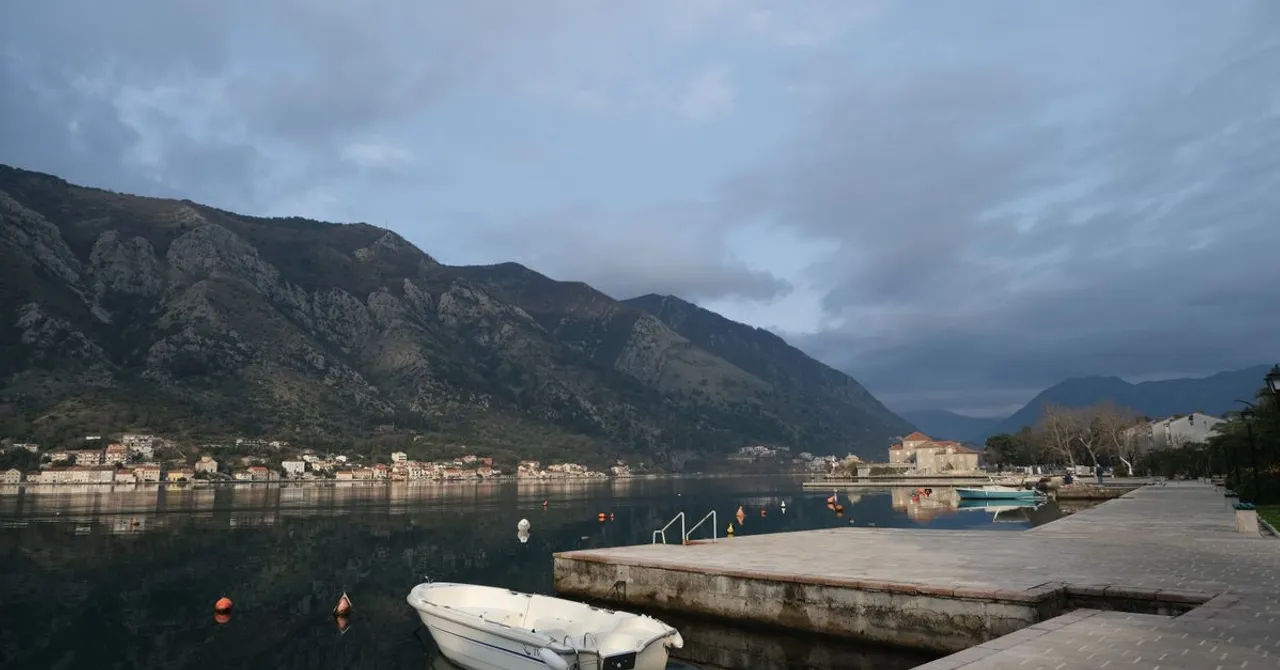
Four nights, and they are not all for Kotor. The walled town itself is small and you will have walked it inside a day, including the climb up the fortifications behind it, which is worth doing early before the heat and before the cruise passengers.
The rest of the time is for the bay, which is the actual attraction: a drowned river canyon ringed with small stone towns, most of them a short bus or boat ride apart. Perast and Our Lady of the Rocks are the obvious ones. Ending the trip here rather than starting it is deliberate, because it is the only stop on the route where doing nothing for a day is the correct use of the day.
How much data two weeks here needs
This route is map-heavy and translation-light. You will navigate constantly, because old towns here are not gridded and bus stations are rarely where you expect, and you will do a lot of live checking of departure times that are not reliably published online. What you will not do is stream much, because you are on buses with views.
| What you are doing | Rough daily use |
|---|---|
| Maps and walking navigation | 150 to 300 MB |
| Checking bus times and booking seats | 50 to 150 MB |
| Messaging and photo sharing | 100 to 250 MB |
| Translation, mostly signage and menus | 30 to 100 MB |
| Browsing and accommodation admin | 100 to 200 MB |
| Occasional video on a long bus leg | 300 MB and up per hour |
That puts most people between 500 MB and 1 GB a day, so 10 GB covers the fortnight comfortably. Go to 20 GB if you plan to work from the road or tether a laptop in the evenings.
Coverage is better than the mountains suggest. All four countries have dense mobile networks along this corridor, and the weak spots are predictable: the canyon sections between Sarajevo and Mostar, and the inland stretch through the hills before Trebinje. Both are on legs where you are sitting still anyway, which is an argument for downloading offline maps for each country rather than for buying more data.
Borders, and what they cost you in time
Three of the four legs cross an international border and no two of them work the same way. Slovenia to Croatia is invisible. Croatia to Bosnia is a Schengen external frontier with full biometric entry and exit checks. Bosnia to Montenegro is a normal staffed crossing run by two non-EU countries, usually quicker than the Schengen one. Knowing which is which is most of the skill.
- Have your passport out of your bag before the bus stops, not after. On a full coach the difference is twenty minutes for everyone.
- Take the earliest bus on the Zagreb to Sarajevo leg. Border queues build through the day and the crossing is the slow part, not the road.
- Keep some cash in each currency. Slovenia and Croatia use the euro, Montenegro uses the euro without being in the eurozone, and Bosnia uses the convertible mark.
- Do not book a same-day onward connection after a bus that crosses a Schengen frontier.
- Screenshot your accommodation address in each country. Border officers ask, and that is the moment your phone decides to hunt for a network.
Before you go
- Install the eSIM at home on wifi. It takes minutes and needs a connection you will not have at a bus station in Bosnia.
- Download offline maps for all four countries, not just the cities. The gaps on this route are between towns.
- Buy the Ljubljana to Zagreb train ticket at the station rather than online. The walk-up cross-border fare is cheaper than most booking sites will show you.
- Check whether your Mostar to Kotor bus goes via Trebinje or via Dubrovnik before you book it.
- Note that the Sarajevo to Mostar train sells tickets at the station, not on the operator's website.
Can I do this route entirely by train?
No, and anyone who tells you otherwise is working from a pre-2016 timetable. The Zagreb to Sarajevo through train has been suspended since December 2016 and Mostar to Kotor has no railway at all. Two of the four legs are buses. The two rail legs, Ljubljana to Zagreb and Sarajevo to Mostar, are both excellent.
Does my EU plan work in Bosnia and Montenegro?
It works, but not at home rates. Neither country is in the EU or the EEA, so roam-like-at-home does not apply. A voluntary agreement between operators keeps at least one product under a set price per gigabyte, but that is a ceiling on one tariff rather than free roaming. Check what your own operator charges before you rely on it.
I read that roaming is free across the Balkans now. Is that wrong?
It is right but it does not apply to you unless your SIM was issued in the region. The Regional Roaming Agreement gave roam-like-at-home to the six Western Balkan economies from July 2021, for their own subscribers travelling among those six. An EU-issued SIM is outside that agreement entirely.
Will one eSIM cover all four countries?
Yes, if you buy a regional plan rather than a single-country one. That is the main practical argument for this route: four countries, two of them outside the EU roaming area, and one plan that does not care where the border is.
How much time do the borders actually add?
Budget an hour for the Croatia to Bosnia crossing on a full bus and rather less for Bosnia to Montenegro. Since April 2026 the EU exit and entry checks are biometric, which is slower than the passport-stamp process older guides describe. It is rarely dramatic, but it is not nothing, and it is why the earliest departure is worth taking.
Booking and official sources
- Slovenske železnice sells the Ljubljana to Zagreb leg and shows you the cross-border fare before you commit to a date.
- HŽ Putnički prijevoz runs the Croatian half of that same train, and is the better source once you are looking at onward travel inside Croatia.
- Željeznice Federacije BiH publishes the Sarajevo to Mostar timetable and the fares, though the tickets themselves are sold at the station.
- Željeznički prevoz Crne Gore is Montenegro's railway, and a useful check on what it does not do: the network runs from Bar up to Podgorica and on north, nowhere near Kotor.
- Plitvice Lakes National Park publishes entry prices and opening hours, and both change with the season.
- The Schengen area is the reference for which of these borders is internal and which is external, which is what decides how long each one takes.
Get a travel eSIM for 200+ destinations in under a minute.
Get your Balkans eSIM →