Two weeks through the Alps: Munich to Milan by train
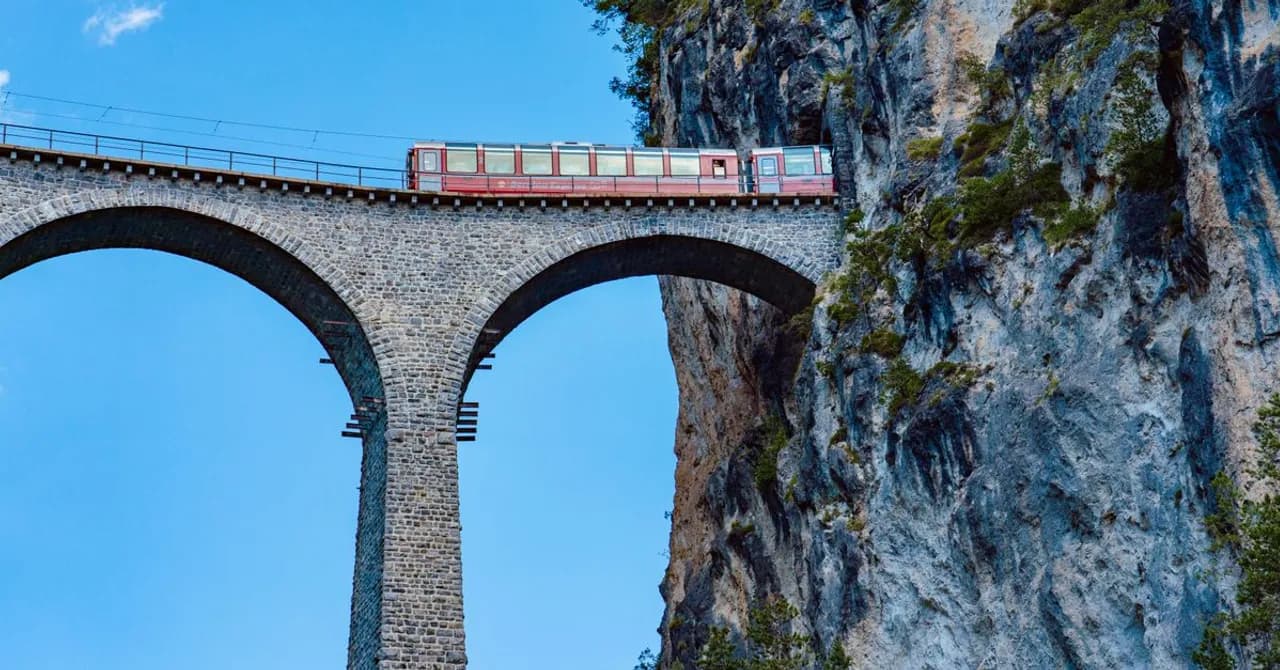
Three countries in fourteen nights, two train legs, no flights. Both legs are much faster than a guidebook printed before 2022 will tell you. Budget 500 MB to 1 GB a day, and note that the middle country is outside the EU roaming rules, so one regional eSIM is doing real work here.
Contents
- The route, leg by leg
- The country in the middle
- Munich, four nights
- Munich to Zurich, the leg that got an hour shorter
- Zurich, five nights
- The Swiss passes, and whether you need one
- Zurich to Milan, and the tunnel that was closed for a year
- Milan, five nights
- How much data two weeks here needs
- Before you go
- Booking and official sources
This is the shortest of our route guides by distance and the one where the connectivity question actually has a wrong answer.
Munich to Milan is two trains and about seven hours of moving. What makes it worth two weeks is what sits between them: Switzerland, which is a country your home operator almost certainly does not treat like home.
The route, leg by leg
Fourteen nights across three bases. Neither leg costs you a day, both run several times daily, and the second one goes under a mountain range through the longest railway tunnel in the world.
| Leg | How | Time | Nights |
|---|---|---|---|
| Munich | Arrive by air | - | 4 |
| Munich to Zurich | EuroCity, tilting Astoro stock | About 3h30 | 5 |
| Zurich to Milan | EuroCity via the Gotthard Base Tunnel | About 3h20 | 5 |
It runs just as well southbound to northbound. Starting in Milan and finishing in Munich means climbing out of the heat rather than into it, which some people prefer in August.
The country in the middle
Here is the thing this route does that no other European itinerary does quite so cleanly. Munich is in the EU. Milan is in the EU. Zurich is not, and neither is anywhere else you will sleep for five of your fourteen nights.
European roam-like-at-home covers the EU plus Iceland, Liechtenstein and Norway, and now Moldova and Ukraine as well. Switzerland is not on that list, and neither is the United Kingdom.
Your EU plan works in Munich, stops working the way you expect in Zurich, and starts again in Milan. Whatever your operator charges for Switzerland is a commercial decision, not a capped one.
Some operators fold Switzerland into their EU zone as a goodwill gesture. Many charge per megabyte, and a few still charge the sort of rates that produce a story. The only safe assumption is that you do not know, so check before you go rather than after.
The absurd part is the geography. Liechtenstein, which you can reach from Zurich in about an hour and a half, is covered by the same rules as Munich and Milan. The country wrapped around it is not.
What happens on the phone is quieter than you would like. Somewhere past St. Margrethen it registers on Swisscom, Salt or Sunrise, and unless your operator sends a warning text, nothing tells you the rules just changed.
That is the practical case for one regional eSIM on this route. Not because roaming is always expensive, but because the border where it changes is the one in the middle of your holiday, five days from either airport.
If you want the wider comparison, we cover it in eSIM versus local SIM versus roaming, and the longer version of this trip is Amsterdam to Budapest by train.
Munich, four nights
Four nights, and the fourth is what turns Munich from a stopover into a base. The city itself needs two: the Residenz and the old town, then a day for whichever museum matches your taste, which in Munich is a real choice rather than a formality.
The other two are for what the regional trains reach. Salzburg is under two hours, the lakes south of the city are under one, and Neuschwanstein is a long but entirely feasible day if that is the picture you came for.
Munich is also the last place on this route where a German SIM would make sense, and it is worth noticing that you are about to leave the market it covers.
Munich to Zurich, the leg that got an hour shorter
Most itineraries still describe this as a slow, awkward connection. It was, until very recently.
The line through Lindau was electrified in 2020 and the journey time fell from 4h45 to 4h01, then again to 3h30 in 2021. Frequency doubled from three trains a day to six, and there are now up to eight. That is a different leg from the one in older guides, and it is the reason this itinerary works with only two moving days.
The trains are tilting Astoro sets with a restaurant car, power at every seat and wifi. Advance Sparpreis fares start around €21.90 in second class, which for a three and a half hour international express is close to absurd.
Book this leg early. The cheap advance fares are the whole economic argument for taking it rather than flying, and they disappear first on the morning departures.
Somewhere around St. Margrethen you cross into Switzerland, and that is the moment your phone changes networks and possibly changes billing. Nothing announces it.
Zurich, five nights
Five nights sounds indulgent for a city with this reputation. It is not, because Zurich in this itinerary is a base rather than a destination, and the Swiss rail network is the reason.
The city gets two days: the lake, the old town, and one of the art museums. The other three go outward. Lucerne is under an hour and is the single best half-day on this route. Bern is under two. The mountain railways up the Rigi and the Pilatus both start from places you can reach on a morning train.
This is the expensive part of the trip and there is no way around that. Swiss prices are what they are. A Swiss Travel Pass or a Half Fare Card pays for itself quickly if you are doing three or more of these day trips, so work that out before you arrive rather than at a ticket machine.
The Swiss passes, and whether you need one
Five nights in Switzerland with three day trips out of them is exactly the case where the pass question stops being academic.
The Swiss Travel Pass gives unlimited travel across the whole Swiss transport system for 3, 4, 8 or 15 consecutive days, and there is a Flex version that spreads the same number of travel days across a month. The Half Fare Card is the other shape: CHF 120 for a month, and then everything is half price.
For this itinerary the Half Fare Card is usually the safer bet. You are based in one city rather than moving daily, and the pass only starts to win when you are on something almost every day and leaning on the mountain railways it discounts.
Work the pass question out at home. Both options are cheaper bought before you arrive, and a ticket machine in Zurich HB at nine in the morning is the worst place to be doing arithmetic in a currency you have not used before.
Zurich to Milan, and the tunnel that was closed for a year
Three hours and twenty minutes, most of it spectacular and twenty minutes of it entirely dark.
The Gotthard Base Tunnel is 57 kilometres long, opened in 2016, and trains cross it in about twenty minutes at up to 250 km/h. It replaced a mountain route of spiral tunnels and switchbacks that is still there and still runs, slower and much prettier.
It also spent thirteen months out of action. A freight wagon derailed inside the tunnel on 10 August 2023 after a wheel fractured, and passenger traffic went back over the mountain while the damage was repaired. The tunnel returned to full service on 2 September 2024, cutting an hour off the run down to Ticino and restoring the half-hourly service.
Anything written between August 2023 and September 2024 will tell you the Zurich to Milan journey is an hour longer than it is. The base tunnel has been back to normal since September 2024, and SBB commissioned trackside derailment detectors on the approaches in May 2026.
If you have the time, take the old mountain line one way. It climbs the valley in spirals, doubling back inside the mountain at Wassen so that the same church appears three times from three different heights, and it is about two hours slower for scenery that justifies every minute.
That line is the reason people used to make this journey rather than fly it. It is still there, still runs, and is now something you choose rather than something you endure.
Lugano sits on the southern side and makes an easy break in the journey. It is Swiss on paper and Italian in every other respect, which is a strange and pleasant hour or two.
Milan, five nights
Milan is the stop people underrate, usually because they gave it a day and saw the Duomo and a shopping street.
Five nights buys you the city properly (the Duomo roof, the Brera, the Last Supper if you booked months ago) and then three days of what the trains reach. Lake Como is forty minutes. Bergamo is under an hour and has an old town most people never see. Turin is under two hours on the high-speed line.
Your data plan should still be running here on the same eSIM it started on, which is the point. Milan is where you notice that the border you crossed twice never became a billing event.
How much data two weeks here needs
This is a lighter route than most, because three well-connected cities means a lot of hotel and café wifi. Maps and tickets are the constant.
| What you are doing | Rough daily use |
|---|---|
| Maps and walking navigation | 150 to 300 MB |
| Tickets, timetables and rail apps | 50 to 150 MB |
| Messaging and photo sharing | 100 to 250 MB |
| Translation, mostly in Italy | 30 to 80 MB |
| Browsing and the occasional video | 100 to 300 MB |
That lands most people at 500 MB to 1 GB a day, so 10 GB comfortably covers the fortnight. Take 20 GB if you are working, or if the day trips mean you are streaming on trains.
Coverage is excellent throughout. Swiss and Austrian alpine valleys are better served than the terrain suggests, and the one genuine gap is the twenty minutes inside the Gotthard Base Tunnel, where you should simply expect nothing.
Before you go
- Install the eSIM at home on wifi, before you are standing in a station with a departure board to read.
- Check what your home operator charges for Switzerland specifically. It is not covered by EU roaming rules and the answer varies wildly between operators.
- Book the Munich to Zurich leg early for the €21.90 advance fare. It is the cheapest three and a half hours in European rail.
- Decide between the Swiss Travel Pass and the CHF 120 Half Fare Card before you arrive, not at the counter in Zurich.
- Reserve the Last Supper months ahead if you want it, or accept that you are not seeing it.
- Download offline maps for all three countries, including the Ticino stretch.
Booking and official sources
- Seat 61's Zurich to Munich page has the current times, the fare structure and which booking site sells what.
- Seat 61's Switzerland to Italy page covers the EuroCity services to Milan, including the Giruno and Astoro stock.
- SBB's news page is the primary source for anything about the Gotthard Base Tunnel's status.
- The EU's own roaming page lists exactly which countries roam-like-at-home covers, which is the fastest way to see that Switzerland is not one of them.
Does my EU roaming work in Switzerland?
Not by law. Roam-like-at-home covers the EU plus Iceland, Liechtenstein, Norway, Moldova and Ukraine. Switzerland is not on that list, so whatever your operator charges there is a commercial decision. Some include it in their EU zone voluntarily, many bill it per megabyte. Check the specific answer for your own tariff before you travel.
How long does Munich to Zurich actually take now?
About three and a half hours, on up to eight EuroCity trains a day. The line was electrified in 2020, which took it from 4h45 to 4h01, and a further timetable change in 2021 brought it to 3h30. Guides written before 2022 describe a much slower journey.
Is the Gotthard Base Tunnel open?
Yes, and has been at full capacity since 2 September 2024. It closed for thirteen months after a freight derailment on 10 August 2023 and traffic went back over the mountain line in the meantime. Anything written during that window overstates the current Zurich to Milan journey time by about an hour.
Swiss Travel Pass or Half Fare Card?
For this itinerary, probably the Half Fare Card. It costs CHF 120 for a month and halves every fare, which suits five nights in one base with a few day trips out. The Travel Pass gives unlimited travel for 3, 4, 8 or 15 days and makes more sense if you are moving nearly every day or planning several of the mountain railways. Buy either before you arrive.
Is two weeks too long for three cities?
Not on this route, because two of the three are bases rather than destinations. Zurich puts Lucerne, Bern and the mountain railways within a morning's reach, and Milan does the same for Como, Bergamo and Turin. If you would rather add a fourth base, Lugano is the natural one.
Should I take the mountain route or the base tunnel?
Both, if you can. The base tunnel is twenty minutes of darkness and gets you there. The old Gotthard line over the pass is about two hours slower and is one of the great railway journeys in Europe. Taking the tunnel one way and the mountain the other costs you half a day and is worth it.
Will one eSIM cover all three countries?
Yes, on a regional European plan. That is the argument on this route more than on most: the country in the middle is the one that falls outside the EU rules, so a plan that treats all three the same removes the only real connectivity decision this trip has.
Get a travel eSIM for 200+ destinations in under a minute.
Get your Europe eSIM →

