Best eSIM for the Philippines: Globe, Smart, DITO
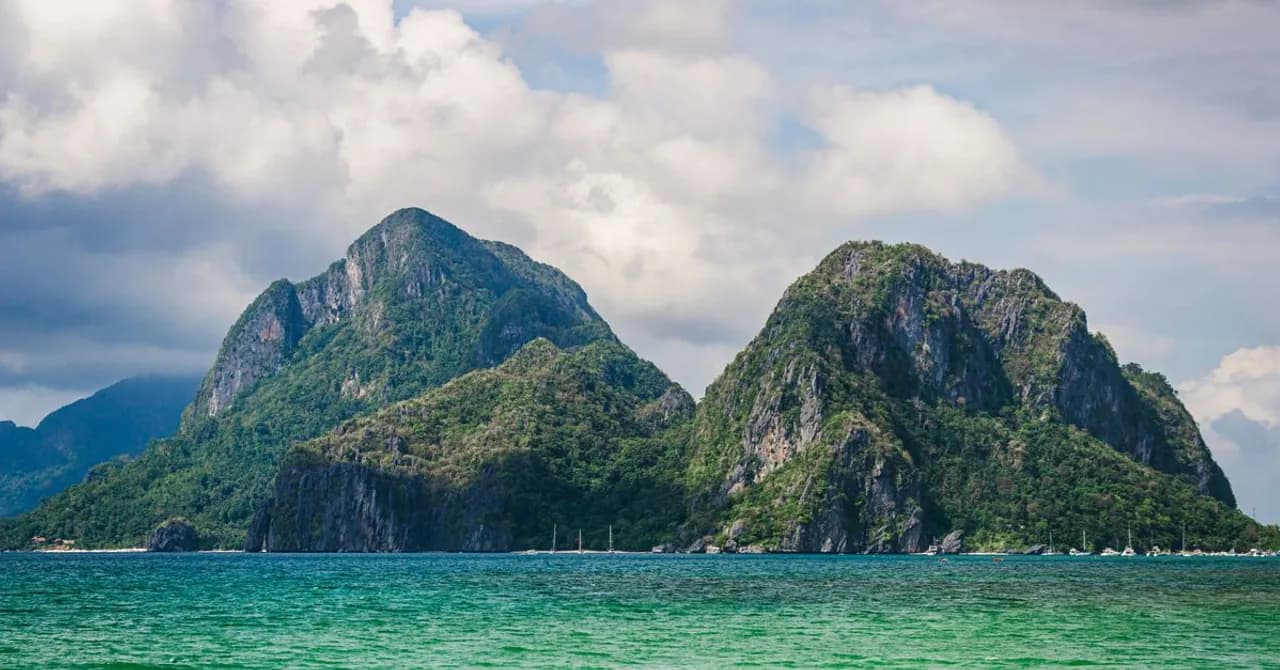
Budget 3 to 5 GB for a week of city days in Manila or Cebu, and 8 to 12 GB for two weeks of island hopping. The bigger decision is the SIM itself: a local prepaid SIM is registered in your name under a law that caps a tourist's registration at 30 days.
Contents
- Why a travel eSIM is the best option for the Philippines
- The word roaming appears zero times in the SIM Registration Act
- The three thirty-day clocks
- What actually eats your data in the Philippines
- A realistic one- to two-week budget
- Globe, Smart and DITO, and which one you are actually on
- El Nido was a landfall point, not a figure of speech
- Before you fly, and the moment you land
- Is your phone eSIM-ready?
The Philippines is 7,641 islands, three mobile networks, and one piece of legislation that most travel advice gets wrong. Coverage is genuinely good where people live, thin the moment you leave, and occasionally absent for days at a time after a storm. Here is what a week or two actually needs, and the paperwork question nobody mentions until you are at the counter.
Why a travel eSIM is the best option for the Philippines
You have three ways to get online: roam on your home plan, buy a local prepaid SIM, or install a travel eSIM before you fly. Roaming is the most expensive per gigabyte by a wide margin. A local SIM from Globe, Smart or DITO is cheap once you have it, but since 2022 it comes with a registration step that has a deadline attached. A travel eSIM installs at home over Wi-Fi, keeps your own number live for calls and texts, and rides the same national networks a local SIM would. Weighing it up? See eSIM vs local SIM vs roaming.
The word roaming appears zero times in the SIM Registration Act
This is the part worth understanding before you land. Republic Act No. 11934, the SIM Registration Act, was approved on 10 October 2022. Its Section 4 requires end-users to register their SIMs "with PTEs as a pre-requisite to the activation thereof". PTE means Public Telecommunications Entity, which is to say a Philippine carrier.
Read the Act looking for yourself as a visitor and you will not find it. The words "roaming", "foreign SIM", "visitor" and "inbound" appear nowhere in the text. "Tourist" appears twice, both inside the same subsection listing what a foreign national must hand over when buying a Philippine SIM. The duty attaches to the sale, not to the airspace.
That distinction has a practical edge. A travel eSIM issued outside the Philippines rides a partner network under a roaming agreement, so there is no Philippine carrier selling you a SIM and therefore nobody to register with. Buy locally instead and the rules below are yours.
Buying a local SIM at the airport? Under Section 5 of the Act, a SIM registered by a foreign national admitted as a tourist "shall only be valid temporarily for thirty (30) days, and shall automatically be deactivated upon expiration". You will also need three things at the counter: your passport, proof of an address in the Philippines, and a return or onward ticket showing your departure date.
The three thirty-day clocks
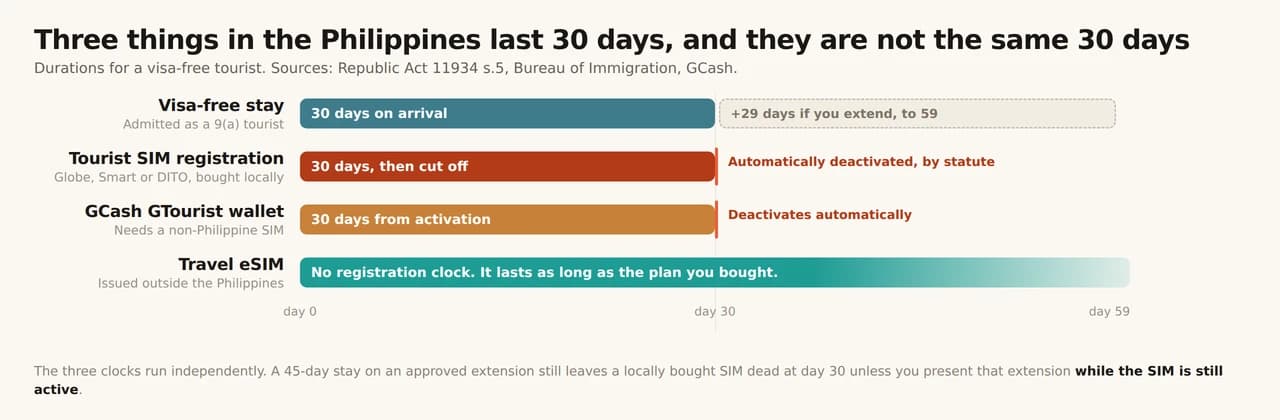
Thirty days turns up three separate times on a Philippine trip, and they are not the same thirty days. Visa-free tourists are admitted for an initial 30 days, extendable by 29 more to a total of 59, per the Bureau of Immigration. A tourist-registered SIM dies at 30 days by statute. And GCash, the payment app, runs a separate tourist wallet on its own 30-day clock.
Only the middle one is avoidable. Stay 45 days on a valid extension and your local SIM still stops at day 30 unless you present the approved extension while it is still active. A travel eSIM has no such clock: its validity is whatever plan you bought.
What actually eats your data in the Philippines
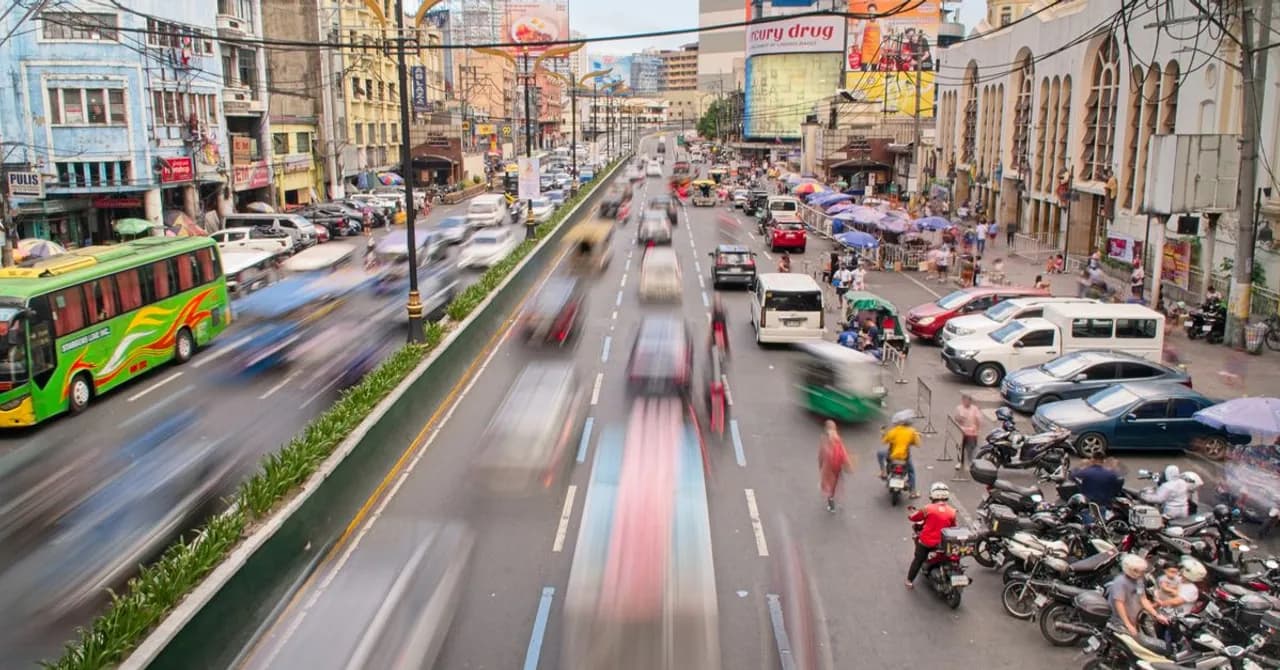
Three things dominate. Facebook and Messenger first, and not by a little: DataReportal's Digital 2026 report puts Meta's Facebook advertising reach at 95.8 million people, about 97.7 percent of Philippine internet users, with Messenger at 65.8 million. Businesses, ferry operators and guesthouses often answer on Messenger and nowhere else.
Maps and ride-hailing come second, and Grab is worth a caveat: it publishes coverage as a finite list of areas, not a nationwide service. Metro Manila, Cavite, Rizal, Baguio, Naga, Pampanga, Cebu, Bacolod, Iloilo, Davao, Cagayan de Oro and Zamboanga City Proper are in. Most of Palawan and Siargao are not, so budget for maps rather than an app that quietly fails.
Photos and video are third and heaviest. Netflix's own figures run 1 GB an hour for standard definition, 3 GB for HD and up to 7 GB for 4K, per device, and uploading a week of island photos is the same arithmetic in reverse.
A realistic one- to two-week budget
Most travelers land between 3 GB and 12 GB, and which end depends far more on trip shape than trip length:
- Light (≈3–5 GB): a week of Manila or Cebu city days on maps, Messenger and light browsing.
- Typical (≈6–9 GB): the above plus island transfers, ferry and flight rebooking, and regular photo uploads.
- Heavy (12 GB+ or unlimited): two weeks island hopping, or you hotspot a laptop to back up dive and drone footage.
| Activity | Rough data use |
|---|---|
| Maps & navigation | ~50 MB / day |
| Messenger chat + calls | ~100 MB / day |
| Social scrolling | ~600 MB / hour |
| HD video streaming | ~3 GB / hour |
Globe, Smart and DITO, and which one you are actually on
There are exactly three networks, confirmed by the GSMA: Globe, Smart (PLDT) and DITO Telecommunity. The budget brands confuse people, so: GOMO and TM are Globe, TNT is Smart. There is no fourth network hiding behind them.
Globe and Smart are the incumbents and the safest bet for coverage away from the cities. PLDT reported 11.2 million 5G devices on the Smart network for full year 2025 in results filed with the US SEC. DITO is the newcomer and has grown fast, reporting 86.30 percent national population coverage at its NTC technical audit in October 2024, up from 80.65 percent a year earlier.
DITO carries one catch a visitor should know. It runs on VoLTE only, and states plainly that its SIM "only works with select DITO compatible VoLTE mobile phones". Apple's own carrier list names only Globe and Smart as Philippine iPhone carriers. A travel eSIM sidesteps the question by riding the incumbent networks.
El Nido was a landfall point, not a figure of speech
Coverage maps do not show weather, and in the Philippines weather is the coverage story. PAGASA, the national weather bureau, publishes an average of 20 tropical cyclones a year entering the Philippine Area of Responsibility, of which 8 or 9 cross the country, with nearly 70 percent forming between July and October.
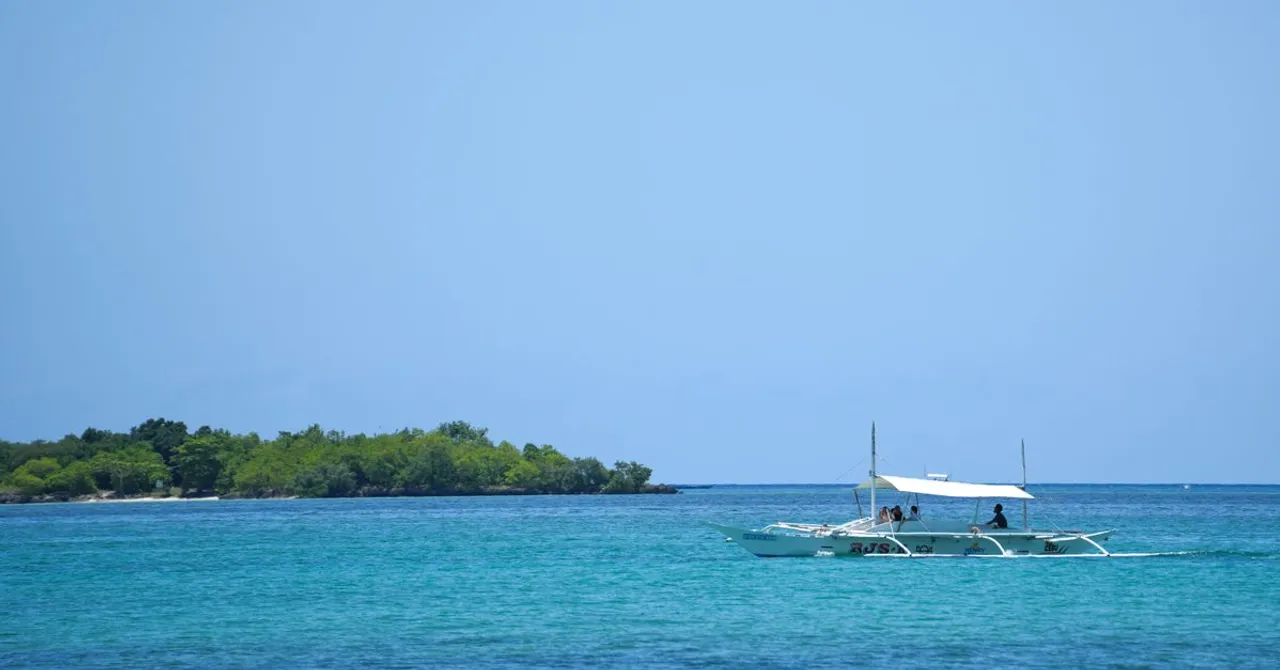
What that means on the ground is specific. Typhoon Tino made nine landfalls on 3 and 4 November 2025, the last of them at El Nido itself at 2050 UTC, the same El Nido on the postcards. PAGASA's own weather station in the Camotes Islands stopped reporting an hour before the eye arrived, knocked out by a telecommunications failure. Tino put 35 provinces under wind signals.
Do not assume a season, either. Tropical Storm Basyang made landfall at Loay, Bohol and Alcoy, Cebu on 6 February 2026, well outside the months travellers are told to watch.
Satellite messaging will not save you here. Apple's Emergency SOS via satellite still does not cover the Philippines as of its July 2026 country list, and Google's Pixel Satellite SOS does not either. When the cell network goes down after a storm, a modern phone has no fallback in this country. Download offline maps before you leave a city.
Before you fly, and the moment you land
Install the eSIM at home on Wi-Fi; it does not start the clock. Most international arrivals land at Ninoy Aquino International in Manila or Mactan-Cebu, though Clark handled 1.7 million international passengers in 2025 and Bohol-Panglao now takes international flights too.
One thing to do before you lose Wi-Fi: the Philippines requires a free online eTravel registration for all arriving passengers, and the government's own FAQ tells you to screenshot the QR code before closing the page. The Bureau of Immigration warns that eTravel is "absolutely free of charge" and that copycat sites have charged travellers ₱3,000 to ₱5,000 for it. Register only on the official domain.
Is your phone eSIM-ready?
Any eSIM-capable phone works on Philippine networks: iPhone XS or newer, Pixel 3 and up, recent Samsung Galaxy flagships. The phone must be carrier-unlocked, and it is worth checking Settings for an available EID before you rely on it. Because the eSIM runs alongside your physical SIM, most travelers keep their home line for calls and select the travel plan for data.
Heading onward? Vietnam, Taiwan and Hong Kong each run on their own national networks, so each leg needs its own plan unless a regional Asia plan already covers the route. Our Taiwan guide runs the same numbers for a Taipei stopover. Ready to pick a size?
Do I need to register a travel eSIM under the Philippine SIM law?
No. The SIM Registration Act applies to SIMs sold and activated by Philippine carriers, which the law calls Public Telecommunications Entities. A travel eSIM issued outside the country roams on a partner network, so there is no Philippine carrier to register with. Buy a local SIM instead and registration is mandatory.
Why does my Philippine SIM stop working after 30 days?
Because the law says so. A SIM registered by a visitor admitted as a tourist is valid for 30 days and deactivates automatically at the end of it. The only way to extend is to present an approved visa extension while the SIM is still active.
What do I need to buy a SIM card at the airport?
Three things: your passport, proof of an address in the Philippines such as a hotel booking, and a return or onward ticket showing your departure date. All three are listed in the Act itself, and the registration is done online rather than on paper.
Is Globe, Smart or DITO best for a tourist?
Globe and Smart have the wider footprint outside the cities and are the two Philippine carriers Apple lists for iPhone. DITO is cheaper and has grown quickly, reporting 86.30 percent population coverage at its October 2024 audit, but it is VoLTE-only and works on a restricted handset list.
How much data do I need for two weeks island hopping?
Budget 8 to 12 GB. Maps and Messenger are light, but ferry and flight rebooking, plus the photo and video most people shoot across Palawan, Siargao or Bohol, is what pushes the total up. Start mid-range and top up if you run low.
Will my phone work on a remote island?
Often, but not everywhere, and not after a storm. Typhoon Tino made landfall at El Nido in November 2025 and knocked a PAGASA weather station's telecoms out an hour before the eye arrived. Neither Apple nor Google offers satellite SOS in the Philippines, so download offline maps first.
Can I use GCash or Grab as a visitor?
Partly. GCash's standard account needs a Philippine SIM, so visitors use its separate GTourist wallet, which requires a non-Philippine SIM and runs for 30 days. Grab covers a published list of cities rather than the whole country, and most of Palawan and Siargao are outside it.
Popular Philippines eSIM plans
Tap a size to see live Philippines prices and buy in a couple of taps.
Get a travel eSIM for 200+ destinations in under a minute.
Get your Philippines eSIM →

