How to use your phone on an Egypt beach holiday
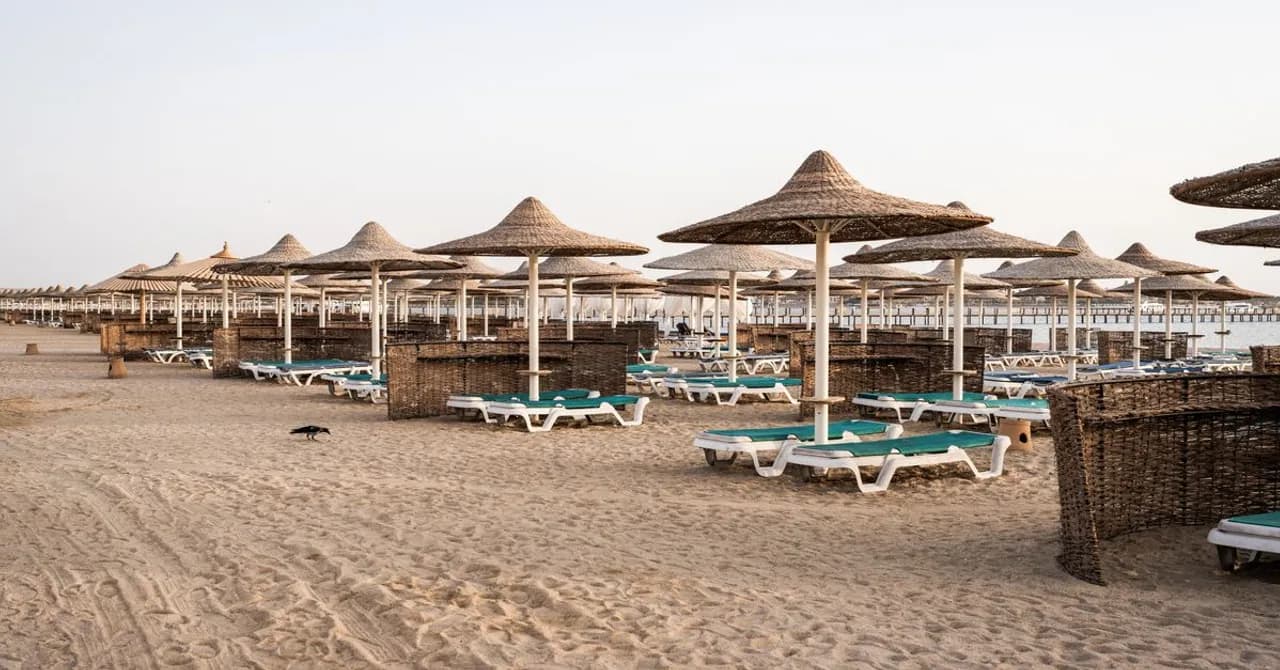
Install a travel eSIM at home, turn on data roaming for that line only and keep your own SIM in for bank texts. Resort Wi-Fi can be slow or lobby-only, home roaming costs extra because Egypt is outside the EU, and signal fades at sea. Budget 3 to 5 GB a week, 6 to 10 GB a fortnight.
Contents
- What resort Wi-Fi is really like
- What your home tariff charges in Egypt
- Where the signal is, and where it stops
- Boat trips, snorkelling and dive days
- Quad, jeep and desert safaris
- The Luxor day trip from Hurghada
- How much data for 7 or 14 nights
- Phone tax and WhatsApp calls: what affects you
- Offline prep for safaris and the Luxor trip
- Setting it up: at home, then on landing
A Red Sea holiday asks less of your phone than a city break, and that is exactly why it catches people out. You land in Hurghada, Marsa Alam or Sharm el-Sheikh, take the transfer to an all-inclusive resort in El Gouna, Makadi Bay, Soma Bay, Safaga or Dahab, and for a week or two the plan is the pool, the reef and a couple of excursions. Then the hotel Wi-Fi turns out to work only at the bar, the roaming text from home arrives with a price per megabyte, and the boat trip leaves signal behind at the jetty.
This guide is for that holiday: a week or a fortnight on the coast, probably a day trip to Luxor, a snorkelling or diving boat, a quad or jeep safari into the desert. It covers what to check about resort Wi-Fi, what the big German, Austrian and Swiss networks charge in Egypt in 2026, where the signal really goes, and how much data you will actually use. For Cairo, the Nile and Egypt's local SIM rules, see our main Egypt eSIM guide.
What resort Wi-Fi is really like
Almost every resort on the coast advertises Wi-Fi, and many include it in the price. What that word covers varies a lot from hotel to hotel, so treat it as a question rather than a promise. Things to check before you rely on it:
- Where it reaches. A listing that says Wi-Fi in public areas often means the lobby, the main restaurant and maybe the pool bar, not your room, the beach or a garden bungalow at the far end of the site.
- Whether it is really free. Some hotels give a basic connection free and charge for a faster tier, or limit how many devices one room can log in.
- How fast it is when everyone is online. A connection that is fine at breakfast can crawl in the evening, when hundreds of guests are uploading the day's photos and streaming in their rooms.
- How you log in. Many hotels use a login page with your room number, and some ask you to log in again every day or on each device.
The quickest way to find out is to read recent guest reviews that mention Wi-Fi, filter for comments from the last few months and ask your tour operator or the hotel directly. Then plan your data on the assumption that the Wi-Fi is fine for messages in the lobby and not much else. If it turns out better, you simply use less mobile data.
Hotel Wi-Fi is also where WhatsApp photos, the cloud backup and app updates should go. Set your phone to back up photos and download updates on Wi-Fi only, and the 300 holiday pictures you take at the reef will not quietly eat your mobile data.
What your home tariff charges in Egypt
Egypt is not in the EU, so the EU rule that lets you use your home allowance abroad does not apply. The big German, Austrian and Swiss operators put Egypt in a world zone outside their home allowance and sell their own passes for it. Here is what the big networks publish as of October 2026. Prices change, so check your own tariff before you fly.
| Operator | Data in Egypt | Source |
|---|---|---|
| Telekom (Germany) | Country group 3. No data without a pass or included volume. Egypt passes (MagentaMobil since August 2024): 1 GB for 7 days €4.95, 5 GB for 14 days €15.95, 12 GB for 28 days €29.95 | Telekom price finder |
| Vodafone (Germany) | ReisePaket World Tag: 500 MB for €9.99 a day. World Woche: 4 GB for 7 days, €34.99. Data Woche: 3 GB for a week, €29.99 | Vodafone ReisePakete |
| O2 (Germany) | Zone 4: €1.49 per MB. Roaming Plus World pack: €14.99 a month including 2 GB in selected countries, Egypt among them | O2 price list |
| A1 (Austria) | With the A1 Roaming Pass option, Egypt is zone 3: €9.90 per gigabyte started | A1 Roaming Pass country list |
| Swisscom (Switzerland) | Egypt country packs: 1 GB CHF 9.90, 5 GB CHF 24.90, 10 GB CHF 39.90, each valid 365 days (prices as announced for June 2025) | Swisscom |
Some of these are honestly not bad. Telekom's 12 GB Egypt pass covers most fortnights, and Telekom's MagentaMobil plans sold since February 2026 include a yearly allowance for country groups 2 and 3, Egypt included, from 2 GB on the smallest plan to 50 GB on XL. A1's €9.90 per gigabyte and Swisscom's 10 GB pack are workable too, and O2's World pack gives 2 GB for the month. If your tariff has a good option, use it. The trouble is the gaps: a Vodafone customer pays €9.99 for each day's 500 MB, or €29.99 for 3 GB for a week, an O2 customer without a pack pays €1.49 for a single megabyte, and a family of four is buying four passes.
A travel eSIM sidesteps the comparison. It is one data plan, bought once, that works the same whichever network you are on at home, and your own SIM stays in the phone with its data roaming switched off. Our Europe-wide roaming comparison covers more carriers, and the Egypt plans show what the same data costs on a travel eSIM.
Data is not the only roaming cost. Your home line still rings in Egypt, and taking a call there costs money: Telekom lists €0.29 a minute for incoming calls in Egypt's country group, O2 €1.59 a minute in its zone 4. Receiving texts is free on Telekom. Let calls you don't need go to voicemail, and tell people at home to message you instead.
One safety net exists for EU customers. Under EU roaming rules, operators must offer a default data cut-off of close to, but not over, €50 a month before VAT, and it also covers roaming outside the EU, unless the network you visit cannot report usage in real time. It stops a disaster. It does not make the bill a good deal: at O2's €1.49 per MB, the cap is reached after roughly 40 MB, and Swiss customers are not covered by it.
Where the signal is, and where it stops
In and around the resort towns, coverage is usually good. Vodafone Egypt's 5G location list names Hurghada, Safaga, Sharm el-Sheikh, Dahab and Luxor. El Gouna, Marsa Alam, Makadi Bay and Soma Bay are not named on that 5G list, which is one operator's 5G footprint rather than a coverage map: expect 4G there, and test the signal in your room on the first evening. Inside a large resort, thick walls and long corridors can weaken it, just as at home.
Three parts of a typical Red Sea holiday leave the towns behind, and each behaves differently.
Boat trips, snorkelling and dive days
A day boat to the Giftun islands off Hurghada, Ras Mohammed off Sharm or a reef off Marsa Alam starts with full bars at the marina. As the boat heads out, the signal fades, and on the outer reefs you should assume you have none. Some spots near islands or the coast pick up a bar or two, but don't count on it for anything urgent. Send messages from the jetty, and download music or a podcast for the trip back.
On a liveaboard, or anywhere well out to sea, a phone can also pick up a ship's own mobile network, billed by your home carrier at maritime rates rather than Egyptian ones. That is one more reason to keep your home line's data roaming off, as our cruise guide explains.
Quad, jeep and desert safaris
Desert trips from Hurghada, Makadi, Sharm or Dahab usually begin a short drive from the coast, and you will often have signal at the start. Once the convoy heads into the hills or the dunes, coverage becomes patchy and can disappear entirely. That is fine for a sunset quad ride, but plan for it: agree a meeting point with your group, keep the tour company's phone number written down and keep the hotel's location saved offline. A phone in your pocket on a quad in the dust also needs a zip pocket or a small bag, more than it needs a network.
The Luxor day trip from Hurghada
Luxor is the classic excursion from the coast, and a long day: an early start, several hours on the road each way through the Eastern Desert, then Karnak, the Valley of the Kings and lunch on the Nile. Luxor itself has good coverage, 5G included. The road can lose signal on its emptier stretches, and inside the tombs there is none at all, because solid rock blocks it. Photos and videos are what use data on this day, so it is worth uploading them that evening on hotel Wi-Fi rather than from the coach.
Staying in Dahab, Nuweiba or Taba? The Gulf of Aqaba is narrow, and Jordan, Israel and Saudi Arabia are just across the water. If your phone ever shows a foreign network's name, open the network settings for your travel eSIM and choose an Egyptian network by hand.
How much data for 7 or 14 nights
On a beach holiday, the biggest variable is not maps or apps, it is how well the hotel Wi-Fi works. If it is good in your room, you need very little. If it is lobby-only, the scrolling, photo uploads and evening video all move onto mobile data. These are rough figures to plan with:
| Activity | Rough data use |
|---|---|
| Messaging, with photos and voice notes | ~150 MB / day |
| Maps and the transfer to and from the airport | ~50 MB / day |
| Social scrolling at the pool | ~600 MB / hour |
| Uploading a day's photos and short videos | ~200 to 500 MB |
| HD video streaming | ~1.5 GB / hour |
| A boat or desert day | Very little, there is often no signal |
- Light, with good Wi-Fi in your room: 2 to 3 GB for a week, 3 to 5 GB for a fortnight. The 3 GB or 5 GB Egypt plan covers it.
- Typical, with Wi-Fi mostly in the lobby, half an hour of scrolling a day and the Luxor trip: 3 to 5 GB for a week, 6 to 10 GB for a fortnight. Take the 5 GB plan for 7 nights or the 10 GB plan for 14.
- Heavy, with poor Wi-Fi, video in the evenings or a hotspot shared with the family: 10 GB for a week and 20 GB or more for a fortnight. The 20 GB plan or an unlimited plan is the calm choice.
GB plans last 30 days, which covers a fortnight with room to spare, and if you run low you can top up in the app instead of buying a new eSIM. Families can share one plan from a parent's phone through the hotspot, or give each teenager their own. Not sure where you'll land? The data calculator works it out from your habits.
Phone tax and WhatsApp calls: what affects you
Two Egyptian rules make the headlines, and neither should spoil a beach holiday. The first is the tax on imported phones. Since 21 January 2026 a phone brought from abroad needs customs fees paid through the Telephony app once its 90-day grace period ends. That clock is about Egyptian SIM cards. Apple's Egypt support page puts it plainly:
This applies to Egyptian SIM cards only and not to iPhone models using roaming.
A travel eSIM connects as a roaming line, so a tourist using one has nothing to register and nothing to pay. Our IMEI guide and the Egypt guide cover the details, including what changes if you buy a local SIM.
The second is internet calling. Egypt has restricted voice and video calls in apps like WhatsApp for years, and the most recent independent assessment, from Freedom House, covering up to May 2025, found the ban still in place. We found no official announcement in 2026 that it has been lifted. In practice, WhatsApp messages, photos and voice notes work normally, while calls may fail, work only on some networks, or work one day and not the next. That is down to the Egyptian networks, so a local SIM behaves the same. Try a call on arrival, and keep your own number in the phone for ordinary calls. More in our WhatsApp calling guide.
Offline prep for safaris and the Luxor trip
Ten minutes on hotel Wi-Fi the evening before an excursion makes the dead spots irrelevant. Our offline prep checklist has the full version. For the Red Sea:
- Download the offline map area in Google Maps for your resort town, and a second one for Luxor if you are going.
- Download the Arabic language pack in your translation app, so menus and signs still translate without a signal.
- Save the excursion voucher, the pick-up time and the tour company's phone number as a screenshot, not just a link in an email.
- Download music, podcasts or a series for the long coach ride and the boat trip back.
- Charge a power bank. Searching for a signal that isn't there drains the battery faster than normal use.
- Tell someone at the hotel or at home where you are going and when you'll be back, especially for desert trips.
Setting it up: at home, then on landing
- Install the eSIM at home on Wi-Fi a few days before you fly. Installing does not start the plan. Our setup guide walks through it.
- Keep your own SIM in the phone. Bank codes and verification texts still arrive on your usual number, and receiving texts while roaming is usually free. If one doesn't arrive, see SMS codes not arriving abroad.
- On landing, set the travel eSIM as your mobile data line and switch on data roaming for that line only. Leave data roaming off on your home line, so it can't run up a bill.
- Check that your phone is unlocked and eSIM-compatible before you buy, especially an older phone bought on contract.
Once your eSIM is installed, leave it alone. Don't delete it and don't tap Install again. The install code works only once, so a deleted eSIM can't simply be put back from the same QR code or link. If your phone says the code is no longer valid, here is what that means. If something looks wrong, contact us before you change anything.
Sort your entry papers at the same time. Most visitors to the Red Sea coast need a visa, which you can buy online from the official portal at visa2egypt.gov.eg or buy on arrival at the bank counter in the passport area, for US$25 according to Egypt's official tourism site. Staying only in Sharm el-Sheikh, Dahab, Nuweiba or Taba for up to 15 days? The same page says you get a free entry permit stamp on arrival instead, valid for those resorts only. Check the current rules for your passport before you book.
Does my German phone contract work in Egypt?
Yes, but Egypt is outside EU roaming, so you pay extra. Telekom blocks data unless your plan includes world-zone data or you book a pass (its Egypt passes run from 1 GB for €4.95 to 12 GB for €29.95), Vodafone sells daily and weekly ReisePakete, and O2 charges €1.49 per MB without a pack. Check your own tariff before you fly.
Is hotel Wi-Fi free in Hurghada?
Often, but check what free means at your hotel. It may only reach the lobby and pool bar, have a paid faster tier or slow down in the evening. Read recent reviews that mention Wi-Fi and plan some mobile data for your room and the beach.
How much data do I need for a week in Hurghada?
Around 3 to 5 GB if the hotel Wi-Fi is mostly in the lobby and you take one day trip. Under 3 GB if the Wi-Fi works well in your room. A fortnight usually needs 6 to 10 GB.
Will I have signal on a snorkelling or diving boat?
At the marina, yes. Out on the reefs, expect little or none on any network. Send what matters before you leave and download something to listen to on the way back.
Do I have to pay Egypt's phone tax as a tourist?
Not with a travel eSIM or your home SIM. The tax and its 90-day grace period apply to phones used with Egyptian SIM cards. A phone on a roaming line, which is what a travel eSIM is, has nothing to register.
Can I make WhatsApp calls in Egypt?
Sometimes. Messages, photos and voice notes work normally, but calls in WhatsApp and similar apps have been restricted for years and we found no 2026 announcement that this has changed. Try it on arrival and keep your own number for normal calls.
Do I need a visa for Sharm el-Sheikh?
Not if you stay only in Sharm el-Sheikh, Dahab, Nuweiba or Taba for up to 15 days. Egypt's tourism authority says you get a free entry permit stamp on arrival. For Hurghada, Marsa Alam or a trip to Luxor you need a visa, online at visa2egypt.gov.eg or on arrival.
Popular Egypt eSIM plans
Tap a size to see live Egypt prices and buy in a couple of taps.


