Does the iPhone 13 support eSIM?
Apple iPhone 13 series · Updated Aug 18, 2026 · 5 min read

Yes. Every iPhone 13, including the mini, Pro and Pro Max, takes an eSIM and keeps its nano-SIM tray, so a travel plan runs as a second line without anything coming out. One regional exception applies, and in Hong Kong and Macao it is the mini that behaves differently from the rest.
The iPhone 13 sits in a comfortable spot for travel. It is new enough that eSIM is standard across the range, and old enough that it still has a tray, so you are never forced to choose between your home number and a travel plan. Apple lists all four models, the 13, 13 mini, 13 Pro and 13 Pro Max, in the eSIM and nano-SIM group of its SIM-type table.
Which iPhone 13 models support eSIM
All four. Unlike the iPhone 14 and later in the United States, no iPhone 13 was sold without a tray, so every one of them can run an eSIM and a physical SIM side by side.
| iPhone 13 variant | eSIM | Physical SIM tray |
|---|---|---|
| iPhone 13 and 13 mini | Yes | Nano-SIM as well |
| iPhone 13 Pro and 13 Pro Max | Yes | Nano-SIM as well |
| Bought in China mainland | No | Two nano-SIM slots |
If you want the general checks rather than this one model, the compatibility checklist covers every brand in order.
The regional exception, and why the mini is the odd one out
In China mainland, only the newest iPhones support eSIM, so an iPhone 13 bought there has none. Hong Kong and Macao are stranger: several models ship with Dual SIM using two nano-SIM cards instead of an eSIM, and Apple's list of eSIM-capable phones for those markets names the iPhone 13 mini while the 13, 13 Pro and 13 Pro Max are in the two-slot group. It is the one case where the smallest model in the range is the one that takes a travel eSIM.
How to add a travel eSIM to an iPhone 13
The install is a scan, not a purchase step, so do it at home on Wi-Fi before you fly. Nothing starts counting down until the eSIM connects to a network at your destination.
- Open Settings, then Cellular, then Add eSIM.
- Choose Use QR Code and scan the code from your order email.
- Give the line a label you will recognise later, for example Zwitchy Travel.
- Leave it switched off until you land, then turn the line on.
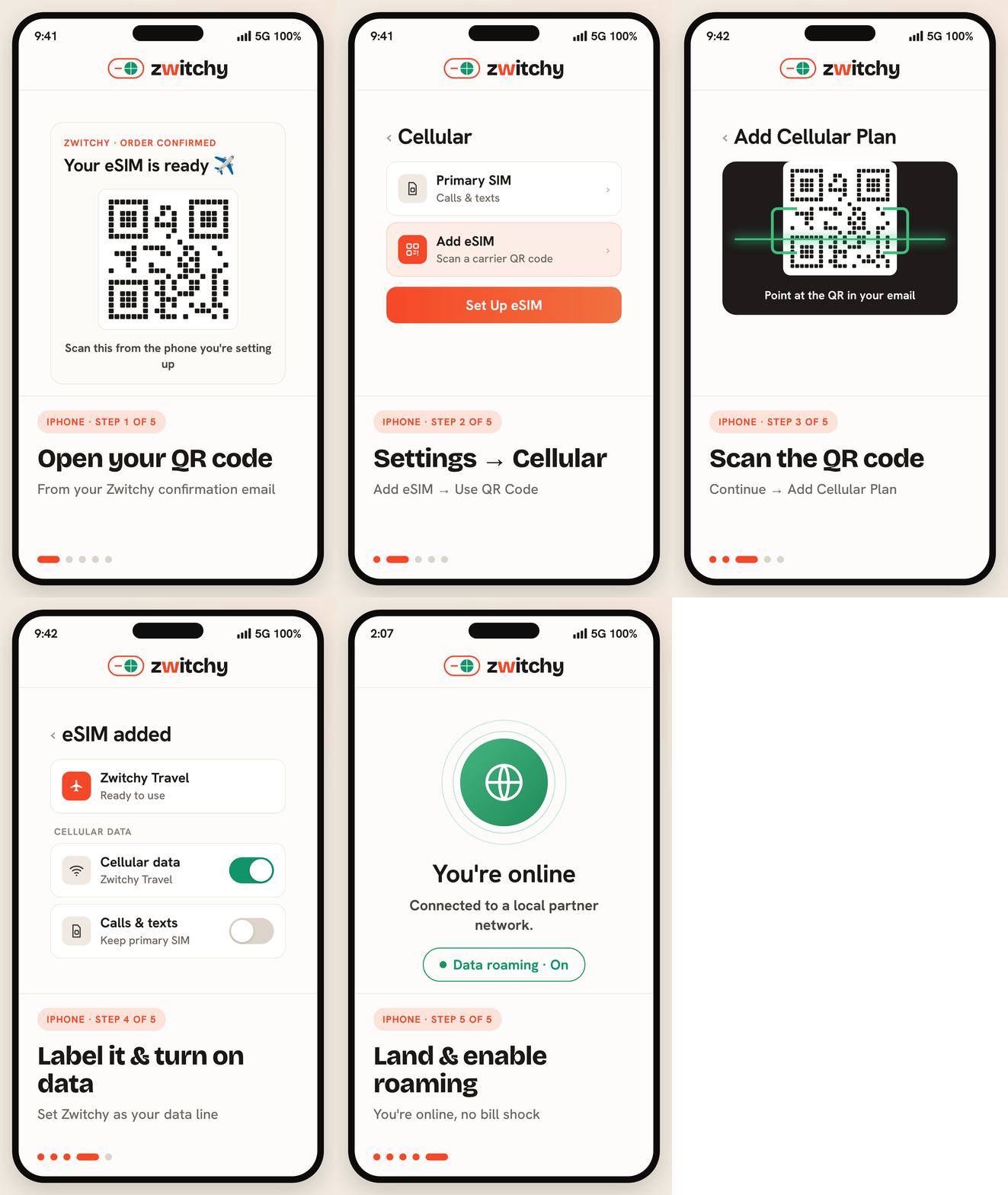
If the camera will not read the code, the same plan installs by typing the details in by hand. Manual activation has the exact fields, and eSIM QR code not scanning covers the rest.
The two settings that decide whether data works
Almost every iPhone 13 that installs an eSIM successfully but shows no data is one of these two settings, not a broken plan. Set Cellular Data to your travel line, and turn Data Roaming on for that line only.
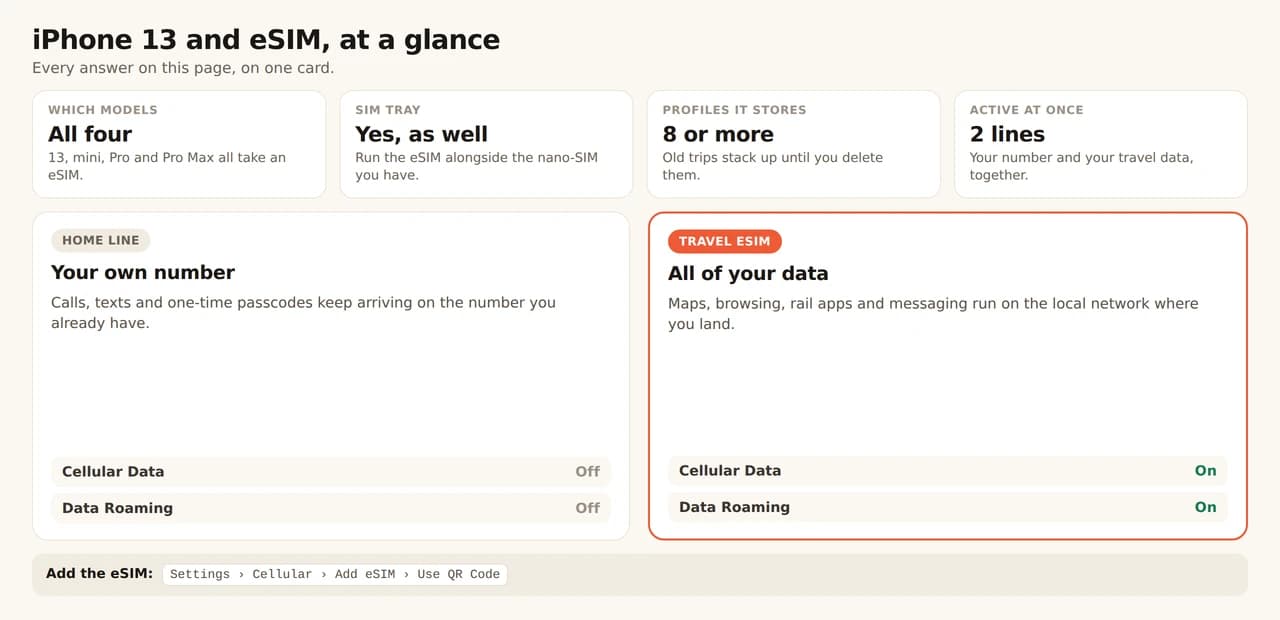
Both screens, in order, are in our dual-SIM line settings guide, and the reasoning behind the roaming switch is in Data Roaming ON: why it is correct.
How many eSIMs an iPhone 13 holds
An eSIM-capable iPhone stores 8 or more eSIM profiles and runs two lines at once. On an iPhone 13 that usually means your nano-SIM plus one travel eSIM, which is all a trip needs. If an install stalls because the phone is full, how many eSIMs your phone can hold explains what is safe to delete first.
Check it is not carrier-locked
eSIM support and a carrier lock are different things, and a locked iPhone 13 will refuse a travel plan even though the hardware is fine. Open Settings, then General, then About, and look for Carrier Lock. No SIM restrictions is what you want to see. Anything else means your carrier still has to unlock it, which is a call to make before you fly, not from the airport.
Using an iPhone 13 across Europe
Because the phone runs two lines at once, a multi-country trip needs no swapping at all: one regional plan stays your data line from the first border to the last. If your route crosses several countries, our Europe plans cover them on a single eSIM, and two weeks in Europe by train works through a five-country route leg by leg with the data each one actually needs.
Does the iPhone 13 mini support eSIM too?
Yes, and in Hong Kong and Macao it is the model Apple lists as eSIM-capable while the 13, 13 Pro and 13 Pro Max ship there with two nano-SIM slots instead.
Do I need to remove my SIM card first?
No. Every iPhone 13 keeps its tray, so the travel eSIM runs as a second line: home number for calls, travel line for data.
Can I install the eSIM before I travel?
Yes, and it is the calm way to do it. Installing loads the profile onto the phone; the plan only starts once the line connects to a network at your destination.
Why does my iPhone 13 show no data after installing?
Two settings, almost always: Cellular Data has to point at the travel line, and Data Roaming has to be on for that line. Check those before assuming the eSIM is faulty.
Is the iPhone 12 the same?
For travel purposes yes: Apple lists the iPhone 12 range in the same eSIM and nano-SIM group, with the same setup path and the same two settings. The Hong Kong and Macao exception also names the 12 mini rather than the larger models.