Best eSIM for Guadeloupe: coverage, cost and 5G
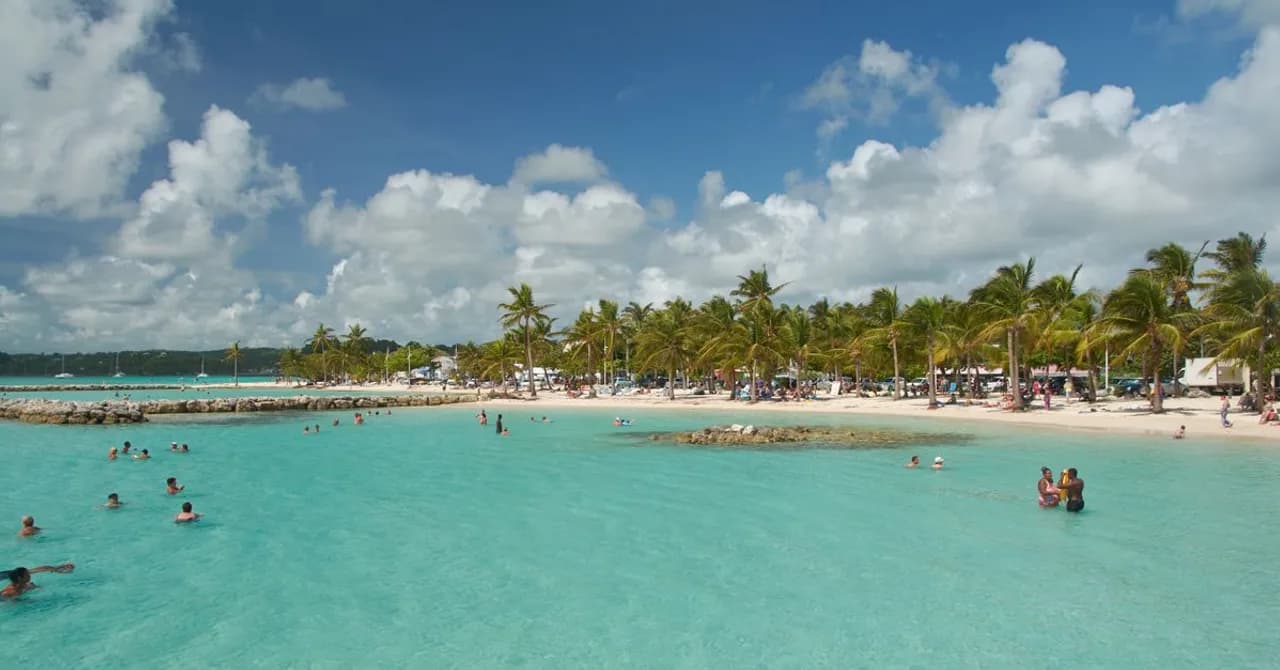
Guadeloupe needs its own eSIM: Zwitchy's regional Caribbean plan doesn't cover it, only single-country plans and France's own overseas roaming do. Budget 3 to 5 GB for a Grande-Terre beach week, or 5 to 7 GB if you add Basse-Terre's rainforest interior and a ferry out to Les Saintes or Marie-Galante.
Contents
Guadeloupe is really two islands stitched together by a bridge: volcanic, rainforest-covered Basse-Terre on the west, and flat, beach-lined Grande-Terre on the east. Add the ferry-only outposts of Les Saintes, Marie-Galante and La Désirade, and one trip can span four or five kinds of terrain in under two weeks.
That variety is also why the eSIM question here isn't quite the same as elsewhere in the Caribbean. Guadeloupe is a French overseas department, using the euro and electing seats in the French parliament like any mainland département, and its four carriers plug into the metropolitan French network rather than the region's usual roaming pool. That's why it sits outside Zwitchy's regional Caribbean plan, and most others like it.
Why Guadeloupe needs its own eSIM, not the regional Caribbean plan
Zwitchy's regional Caribbean plan covers 11 islands built around the CARICOM roaming pool, not Guadeloupe. Its four carriers, Orange Caraïbe, SFR Caraïbe, Digicel AFG and Free Caraïbe, wire into mainland France's network instead, not the Anglophone Caribbean's wholesale deals. Book a regional Caribbean eSIM expecting it to cover a Guadeloupe stop, and it won't connect.
A global eSIM plan built on the widest tier-1 network footprint is the other way a traveler sometimes stumbles onto Guadeloupe coverage by accident, but it's rarely the cheapest fix for a trip that's only ever going to touch French Caribbean soil. For a Guadeloupe-only trip, or one paired with Martinique, a single-country plan is the better buy, save the wider options for when the itinerary is genuinely open-ended.
Guadeloupe joins Cuba, Trinidad and Tobago and Martinique on the short list of Caribbean names outside every regional plan's network deals. Each needs its own single-country eSIM, not a broader Caribbean bundle.
What actually eats your data in Guadeloupe
A rental car and Waze or Google Maps do most of the work here: the Route de la Traversée cuts across Basse-Terre's national park, and Grande-Terre's coast road links Pointe-à-Pitre's market to the beach towns of Le Gosier and Sainte-Anne. WhatsApp, not LINE or KakaoTalk, is how most visitors stay in touch, French and French Caribbean phone habits both run on it.
Add snorkeling photos from the Grand Cul-de-Sac Marin reef or a hike to the Carbet Falls, and video uploads still do the real damage to a data allowance, not maps or messaging.
A realistic one- to two-week budget
Most trips land between 3 GB and 8 GB for one to two weeks, and how much of it is Basse-Terre versus Grande-Terre, plus any outer-island ferry, is what moves the number:
- Grande-Terre beach time (≈3–4 GB): Le Gosier, Sainte-Anne and Saint-François's beaches and resorts sit on dense coastal coverage.
- Add Basse-Terre's interior (≈5–7 GB): more offline map use on the Route de la Traversée and around La Soufrière, with less signal to fall back on off the coast road.
- Island-hopping to Les Saintes or Marie-Galante (8 GB+): ferry crossings, a fresh round of photos on each island, and hotspotting a laptop to back them up.
The outer islands each add their own short crossing: Trois-Rivières to Les Saintes runs about 20-25 minutes, the fastest way across, while Saint-François to Marie-Galante takes roughly an hour and Saint-François to La Désirade about 45 minutes. None of the four carriers reach far past the coastline, so budget on losing signal entirely for the length of each crossing, not just a weak bar or two.
| Activity | Rough data use |
|---|---|
| Maps & driving directions | ~50 MB / day |
| WhatsApp messaging + calls | ~100 MB / day |
| Social scrolling | ~600 MB / hour |
| HD video streaming | ~1.5 GB / hour |
Before you fly, and the moment you land
Install the eSIM at home on Wi-Fi, it doesn't start the clock. If a Schengen visa or day-counter tells you it covers Guadeloupe, it doesn't: Guadeloupe sits outside the Schengen Area entirely, so time spent here neither uses up nor is limited by a Schengen 90-day allowance, though France's own separate short-stay rules still apply to non-EU visitors. Every flight lands at Pôle Caraïbes Airport (PTP) near Pointe-à-Pitre. Once through, set Zwitchy as your data line and switch on Data Roaming for it (that just means "use the eSIM's partner network," never your home carrier), and you'll be online before the rental-car counter.
Is your phone eSIM-ready?
Any eSIM-capable phone works on Guadeloupe's networks: iPhone XS/XR or newer, Google Pixel 3 and up, and recent Samsung Galaxy flagships. Two catches, the phone must be carrier-unlocked, and it's worth checking Settings → General → About for an available EID before you rely on it. Because the eSIM runs alongside your physical SIM, most travelers leave their home line in for calls and texts and simply select Zwitchy for mobile data.
The one gap: La Soufrière and Basse-Terre's rainforest interior
Basse-Terre earns its name oddly: "low land" in old Norman French for what is actually Guadeloupe's mountainous half, capped by La Soufrière, an active volcano rising to 1,467 meters, the highest point in the Lesser Antilles. The Parc National de la Guadeloupe covers most of the interior, dense rainforest, the Carbet Falls, and the Route de la Traversée cutting straight through it. Signal from all four carriers thins out fast once the coast road disappears behind you; on the volcano's upper slopes and deep in the forest, expect no signal at all, that's the terrain, not a network limit.
Orange and SFR switched on Guadeloupe's first 5G on 18 February 2025, when Arcep authorized the 700 MHz and 3.4-3.8 GHz bands for the island, with the 900 MHz band following on 1 May 2025. Orange's own coverage page lists Pointe-à-Pitre, Baie-Mahault, Les Abymes and Basse-Terre town as live, all on Grande-Terre's coast or the edge of Basse-Terre town, not the interior. Away from those towns, 4G is what you'll actually get, plenty for maps and WhatsApp, just don't expect 5G speeds mid-hike.
Adding Martinique or Dominica to the trip? Martinique runs the same four French Caribbean carriers and needs its own eSIM for the same reason Guadeloupe does, while Dominica already sits on Zwitchy's regional Caribbean plan, no separate purchase needed if that plan already covers the rest of your route. Weighing the eSIM against roaming or a local SIM first? See eSIM vs local SIM vs roaming. Ready to pick a size?
Does Zwitchy's regional Caribbean eSIM plan cover Guadeloupe?
No. Guadeloupe's four carriers plug into mainland France's network rather than the CARICOM roaming pool the regional plan uses, so it needs its own single-country eSIM.
Which network will my eSIM use in Guadeloupe?
Zwitchy's Guadeloupe plan rides the island's partner networks among Orange Caraïbe, SFR Caraïbe, Digicel AFG and Free Caraïbe, the same four carriers behind the island's 4G and, since February 2025, 5G.
Do French or EU mobile plans roam free in Guadeloupe?
Yes, for mainland French and EU plans under roam-like-at-home rules, but that only helps residents traveling on their own French or EU SIM, not visitors from elsewhere, who still need a local option or a travel eSIM.
Will I have signal on La Soufrière or in the Parc National de la Guadeloupe?
Rarely. Coverage from every carrier thins out fast past the coast road, and the volcano's upper slopes and the deep rainforest interior often have none at all. Download offline maps before you set out.
How much data do I need for a week that includes Les Saintes or Marie-Galante?
Budget toward 8 GB or more. Ferry crossings mean stretches with no signal, and most travelers photograph both islands heavily once they arrive.
Is my phone eSIM-compatible for Guadeloupe?
Any eSIM-capable phone works: iPhone XS/XR or newer, Google Pixel 3 and up, and recent Samsung Galaxy flagships, as long as it's carrier-unlocked.
How long is the ferry crossing to Les Saintes or Marie-Galante, and will I have signal on it?
Trois-Rivières to Les Saintes is the shortest crossing at 20-25 minutes; Saint-François to Marie-Galante runs about an hour. Expect no signal for the whole crossing on either route, all four carriers stop at the coastline.
Popular Guadeloupe eSIM plans
Tap a size to see live Guadeloupe prices and buy in a couple of taps.
Get a travel eSIM for 200+ destinations in under a minute.
Get your Guadeloupe eSIM →

